At a glance
Expert’s Rating
Pros
- Easy to use & reliable
- Works with various slicers
- Great print quality
Cons
- Fan runs Constantly during printing
- Requires post-printing cleanup + curing (like all resin printers)
- More expensive than some rivals
Our Verdict
The Halot One Plus is an easy-to-use resin 3D printer that has a good-sized build volume, prints reliably and at high quality. It’s quite expensive compared to rivals, especially in the UK.
Best Prices Today: Creality Halot One Plus

I’ve become something of a 3D printing addict over the past few years, but the Halot One Plus is my first foray into resin printing.
For those new to 3D printing, or just to resin printers, it’s important to understand there are major differences between resin printers and FDM printers (the type that print using a spool of filament), such as the Creality Sermoon V1 Pro .
This isn’t the place to compare the two technologies, but it is worth knowing from the outset that with a resin printer like the Halot One Plus, you’ll need a ‘wash and cure’ station as well. Unlike an FDM printer, when the Halot One Plus has finished printing, this isn’t the end of the process: uncured resin must be cleaned from the print (along with supports), then it must be cured using UV light.
Getting to the Halot One Plus itself, it’s the flagship model in the Halot One range, which also includes the Pro and Halot One . It has the largest build volume of the three, the biggest LCD and highest resolution.
It’s no surprise that it’s more expensive, but the question is whether it’s worth buying. Let’s find out.
Features & design
- 7.9in monochrome LCD
- Proprietary light source
- 4.9in touchscreen
- 172 x 102 x 160mm build volume
Compared to an FDM printer, the Halot One Plus is fairly compact and completely enclosed. It measures 236x243x418mm and weighs a little under 7kg. The cover is required to protect your eyes from the UV light, and it’s such a dark shade of blue it’s hard to see through it.
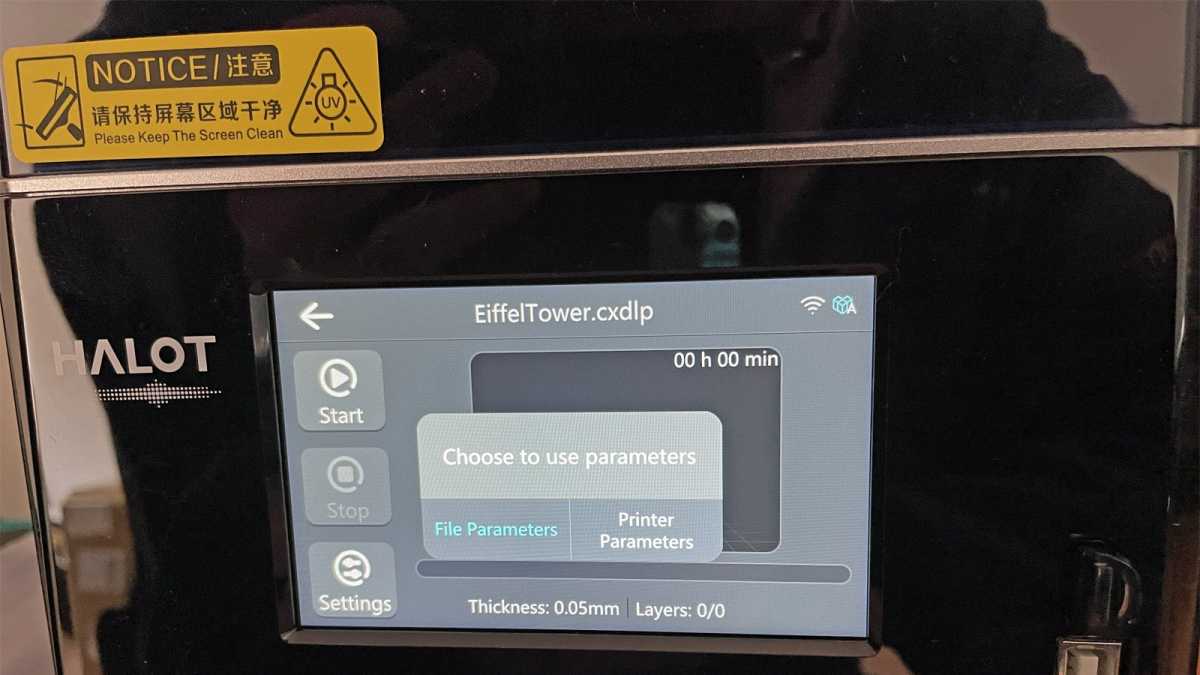
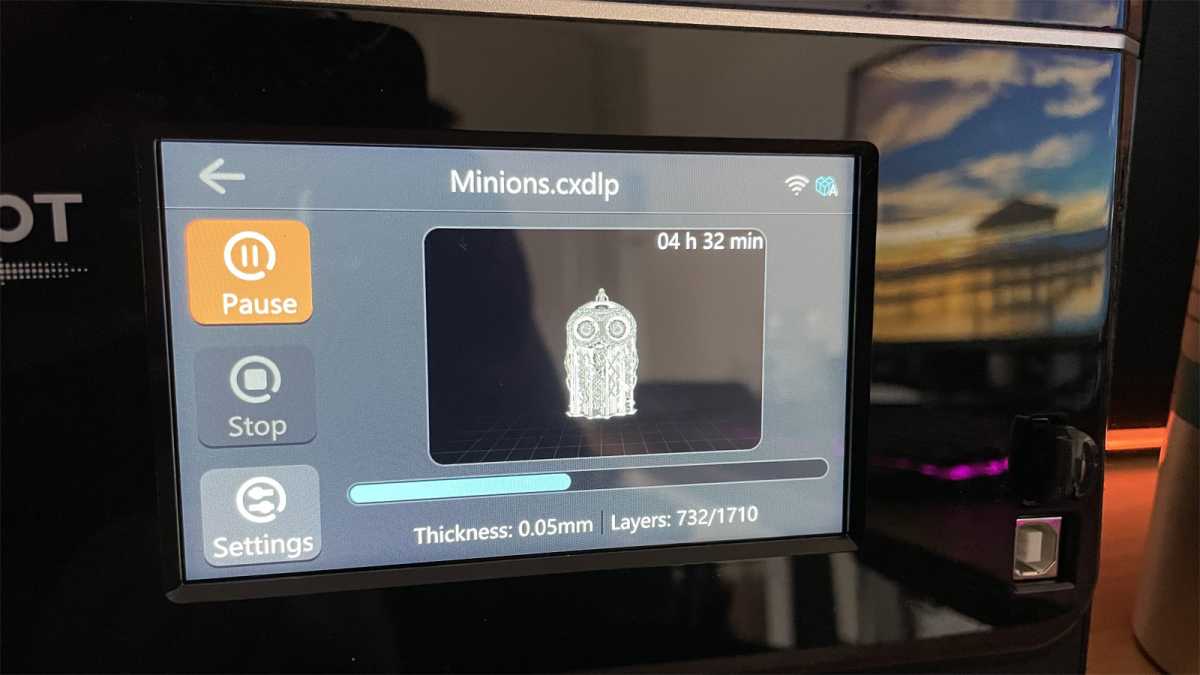
Fortunately, the large displays progress so you can see how much print time is remaining and how many layers have been printed (out of the total). It’s a capacitive touchscreen, like a phone, and this makes it simple to navigate menus, change settings, choose models to print and enter your Wi-Fi password.
Jim Martin / Foundry
Next to the screen are two USB ports, one for a flash drive containing print files and a type-B port for direct connection to a PC.
The built-in Wi-Fi means wired connection is something you’re unlikely to use, and there’s even access to Creality’s Cloud service that allows you to download prints on the printer itself. The Halot One Plus can then slice these models and print them.
I’ve seen a lot of people claim that some of the models available are “stolen” and are breaking copyright, so if you want to avoid inadvertently printing something you should have paid for, it might be best to source your models elsewhere.
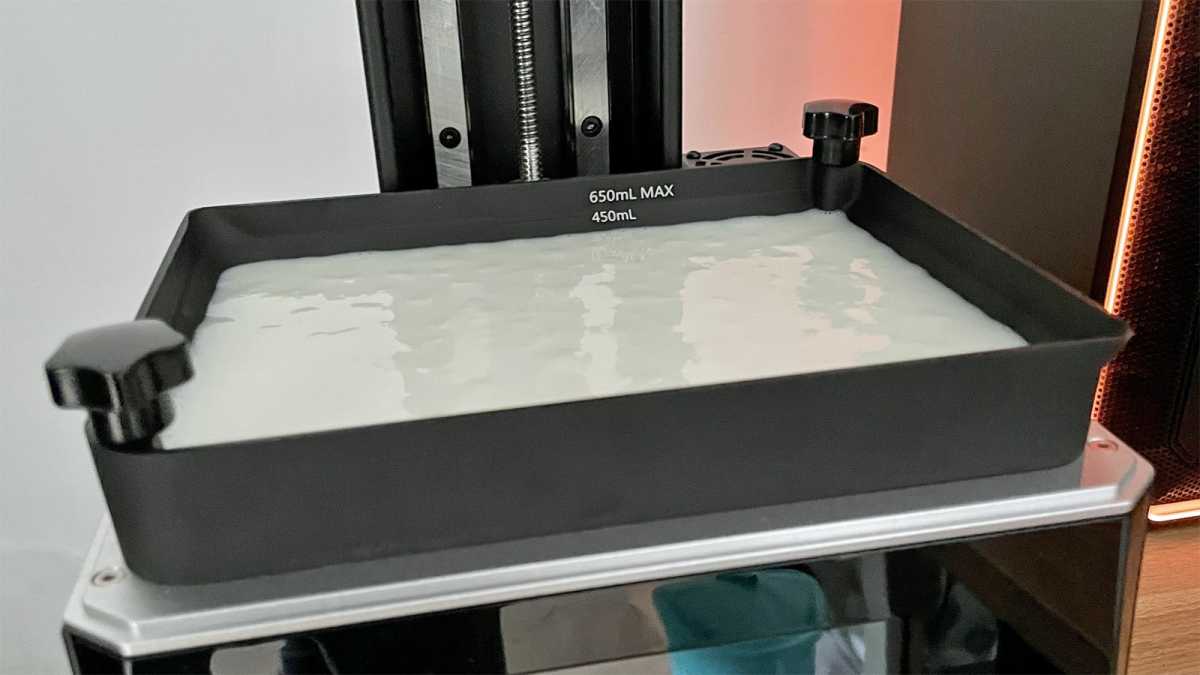
Under the cover you’ll find a metal resin tray with a transparent FEP sheet screwed to the bottom. There’s a spare included in the box, which is handy.
Jim Martin / Foundry
The tray has markings for 250, 450 and 650ml and also has captive screws so you can’t lose them. On two opposite corners are lips that allow unused resin to be poured more easily back into the bottle.
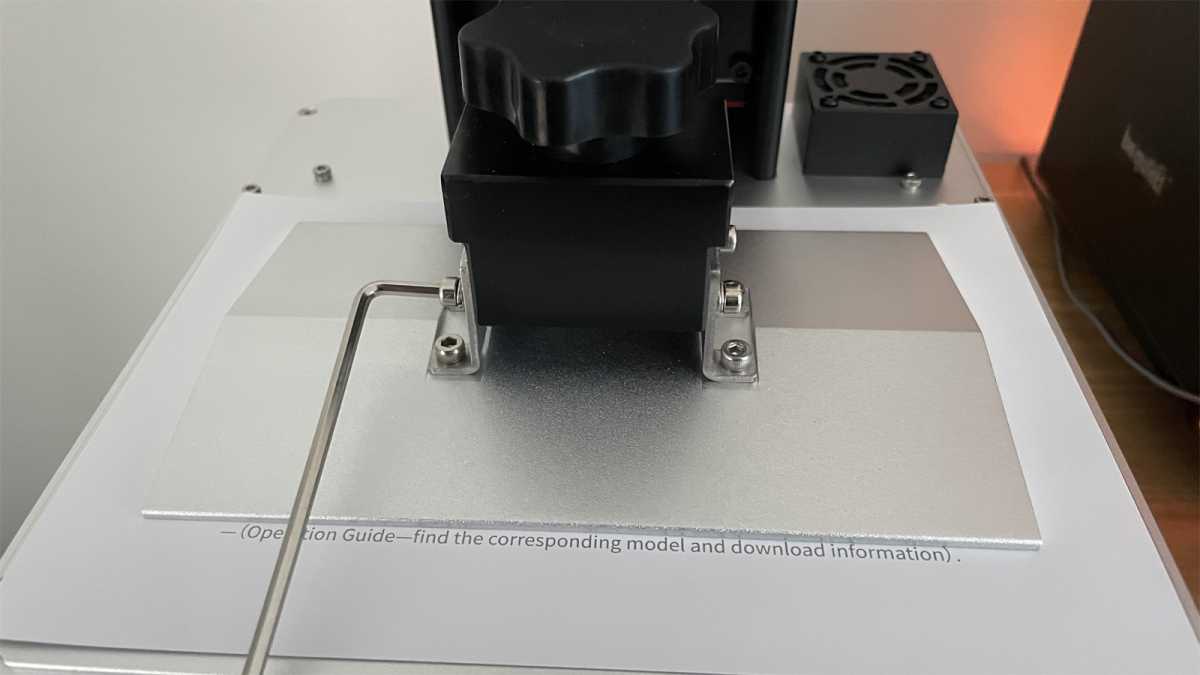
The aluminium build plate has four Allen bolts that need to be loosened before levelling. This is a simple process (compared to an FDM printer) which requires you to place the calibration sheet on top of the LCD screen, then tighten the bolts once the build plate has been lowered on top of the sheet.
Jim Martin / Foundry
The top of the build plate is angled to help resin run off, but really needs a steeper pitch as some resin remains after printing, and gets caught around the bolts.
The 7.9in LCD has a resolution of 4320×2560, which is higher than a lot of resin printers. As with graphics, a higher resolution means a smoother-looking print, while a lower resolution means prints are blockier. This is one of the reasons the Halot One Plus costs more than lower-resolution resin printers.
However, because resin 3D prints are created by shining UV light through the screen, it’s important that this light is even across the screen. Many resin printers use a UV LED matrix, but Creality has developed its own ‘integral light source’ which it says can reach over 90% “evenness”, compared to around 50% for resin prints using ‘parallel emission’.
Also, because it uses far fewer LEDs than a matrix, there are supposedly fewer problems with broken units within the matrix.
The Halot One Plus can print 0.01mm layers and has an XY axis precision of 0.04mm. It has dual rails on the Z-axis which should help ensure no deviation for tall prints.
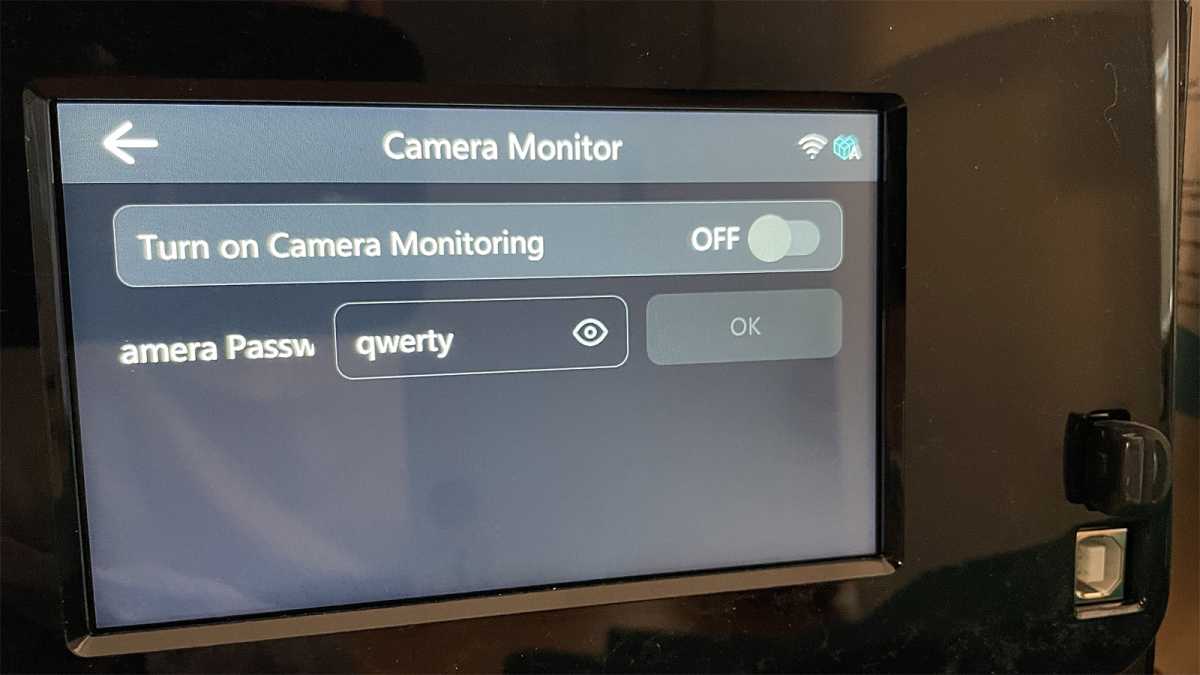
It’s good that firmware updates are possible over the air via Wi-Fi, and Creality says that its team is working on adding webcam support. Confusingly, there are references to cameras in the menus already, but what really threw me was that the ‘Camera password’ in the Camera Monitor settings is actually the password (token) you need to set if you want to print over Wi-Fi from a PC.
Jim Martin / Foundry
Having webcam support would be good if the cover wasn’t so dark that is isn’t possible to see clearly what is being printed, as the camera would have to be placed outside of the cover.
With two fans, one for the UV LED and a second for the activated charcoal filter, the One Plus is relatively noisy as the fans run continuously while printing. Using Creality’s own resin, the odour wasn’t too bad, but it certainly appeared that the filter wasn’t able to neutralise the smell completely.
There aren’t many accessories included in the box: just a plastic scraper, a single paper filter (for pouring resin back into the bottle) and a few Allen keys. There are no flush cutters for removing supports, nor any gloves, so these and some IPA (isopropyl alcohol) to clean prints are the extras you’ll need to get as a minimum.
You might also want to buy Creality’s UW-02 washing and curing machine which costs $219 / £179.
Slicers
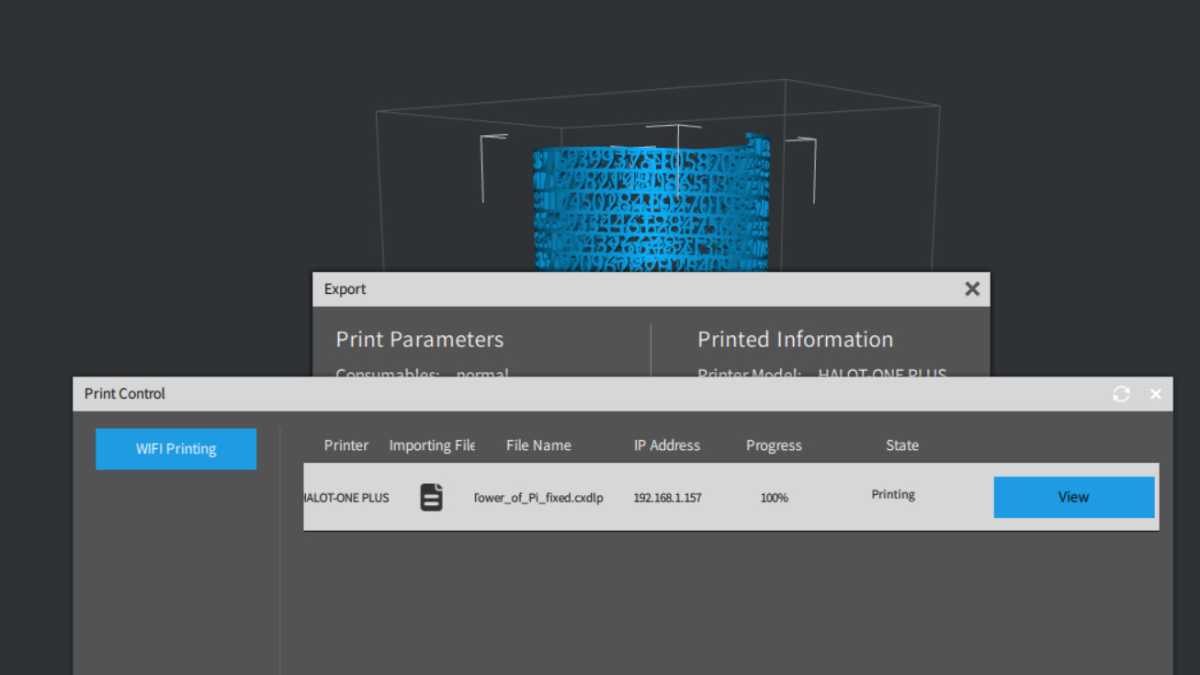
You have a choice of slicers. There’s Creality’s own Halot Box, Lychee Slicer and ChiTuBox. As I hadn’t used any of these, I went with Halot Box.
Creality
It’s relatively straightforward, though you will need to learn how to add supports to resin models. The auto-generated supports weren’t placed in the most sensible places, so it’s worth spending the time to manually add them where you want them.
You can export the sliced model to a USB drive, or print direct to the Halot One Plus over Wi-Fi, after setting and entering the password, and the software will estimate the print time and how much resin will be used.
Printing
For the first print, I downloaded a Minion model from Creality Cloud and used the default print settings. Surprisingly, it printed perfectly with no problems whatsoever – the complete opposite of just about every FDM printer I’ve reviewed.
Jim Martin / Foundry
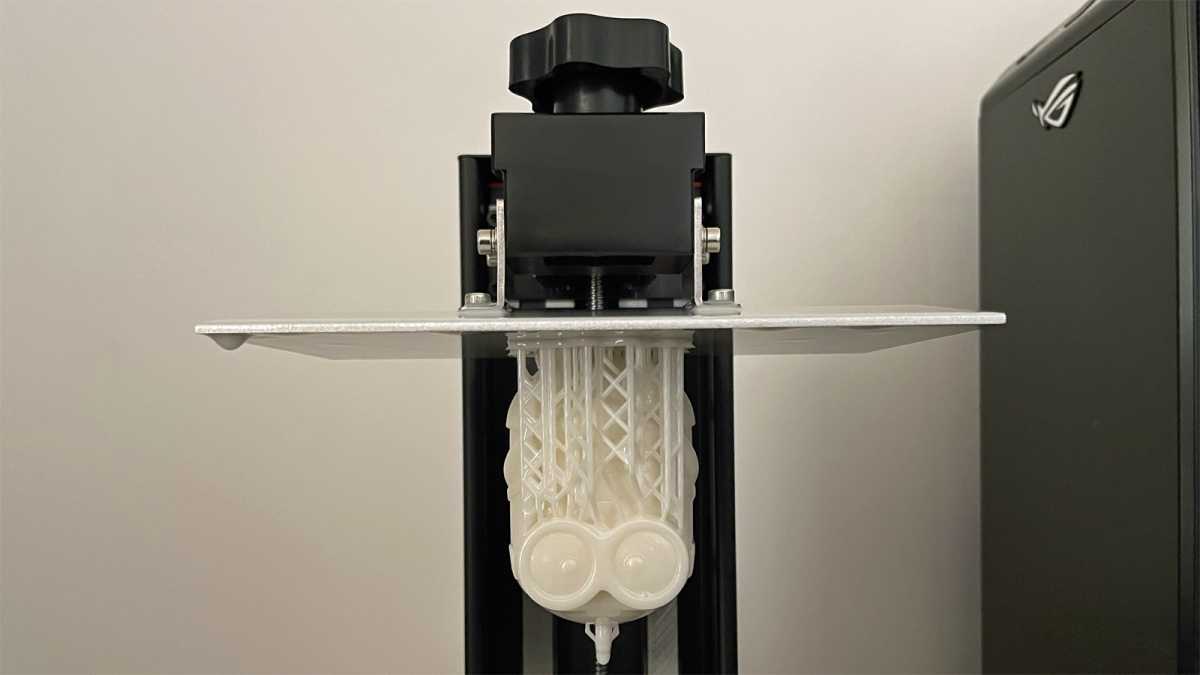
The plastic scraper removed the model from the build plate and, since I didn’t have a wash-and-cure machine to hand, I used a bath of IPA to clean the uncured resin and then left it outside in the sun for a good few hours.
Jim Martin / Foundry
Resin prints do change colour when cured, so the white resin took on an almost peach shade once cured.
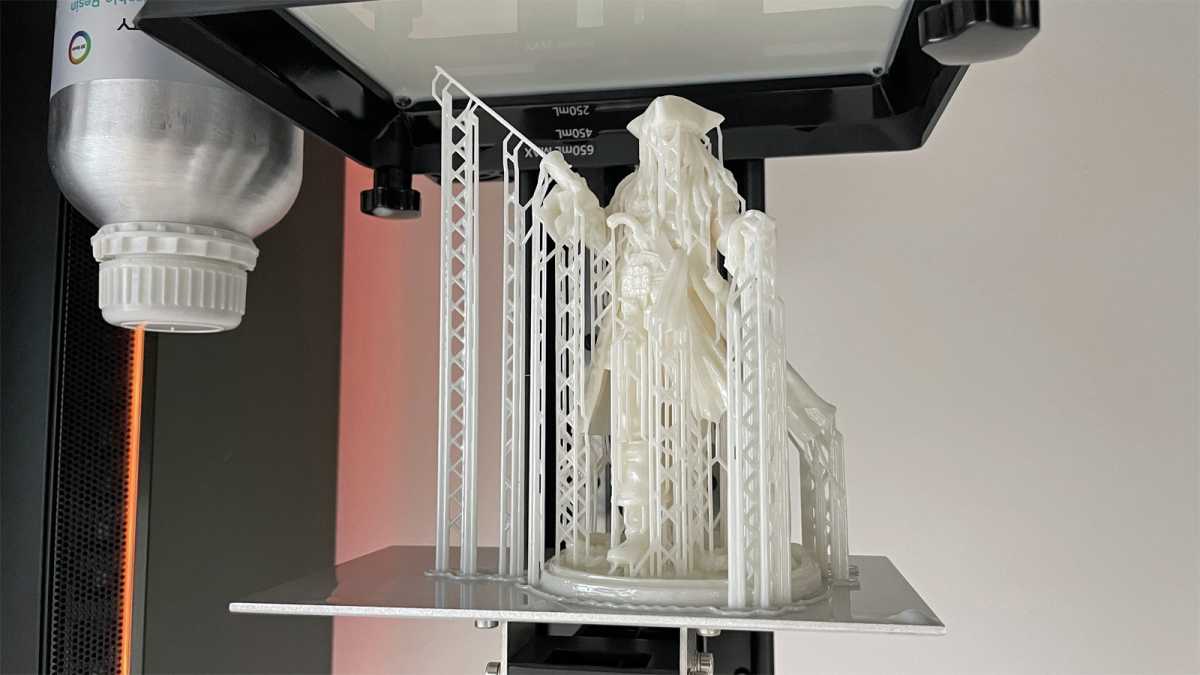
For the second test, I opted for something much more difficult: a model of Captain Jack Sparrow which filled a good proportion of the maximum height. This took a little over 13 hours to print but, once again, printed successfully first time.
Jim Martin / Foundry
Detail was exceptionally good, with great texture in the beard, jacket, wooden floor and rope.
Resin prints are a little flexible before they’re fully cured, and can become brittle at that point, so you have to be careful not to snap pieces off, such as the sword. In this model, one of the two chin braids snapped off when removing a support.
The main problem with this print was that it was stuck so fast to the build plate it was extremely difficult to remove. I had to resort to a metal scraper, and even then, it was tough to prise it off. Reducing the first-layer cure time largely fixed this for subsequent prints, though.
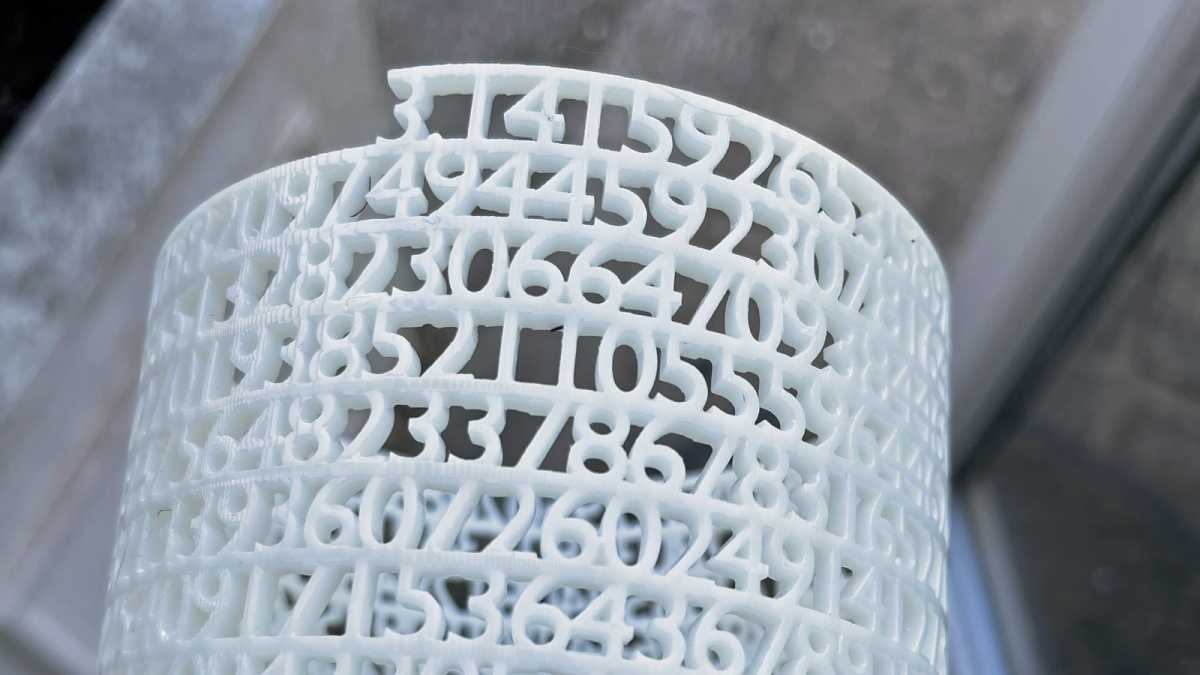
Yet another test was the challenging Tower of Pi. This is virtually impossible on an FDM printer, which is why the designed created a version with walls. But the Halot One Plus took it in its stride, printing almost perfectly at 100%, which is 150mm tall and 85mm wide.
Jim Martin / Foundry
The only imperfections were a few filled in holes in some of the number 8s. You can also see stepping around the edge (on the left-hand side of the image above), though this wasn’t present all the way around – some areas appeared perfectly smooth, so it’s not simply the 0.04mm XY resolution coming into play.
Importantly, there were no issues at all with Z-axis accuracy, and prints with vertical surfaces were also nice and smooth.
Overall, print quality is excellent, and the great light uniformity means you can use the full area of the build plate without sacrificing quality.
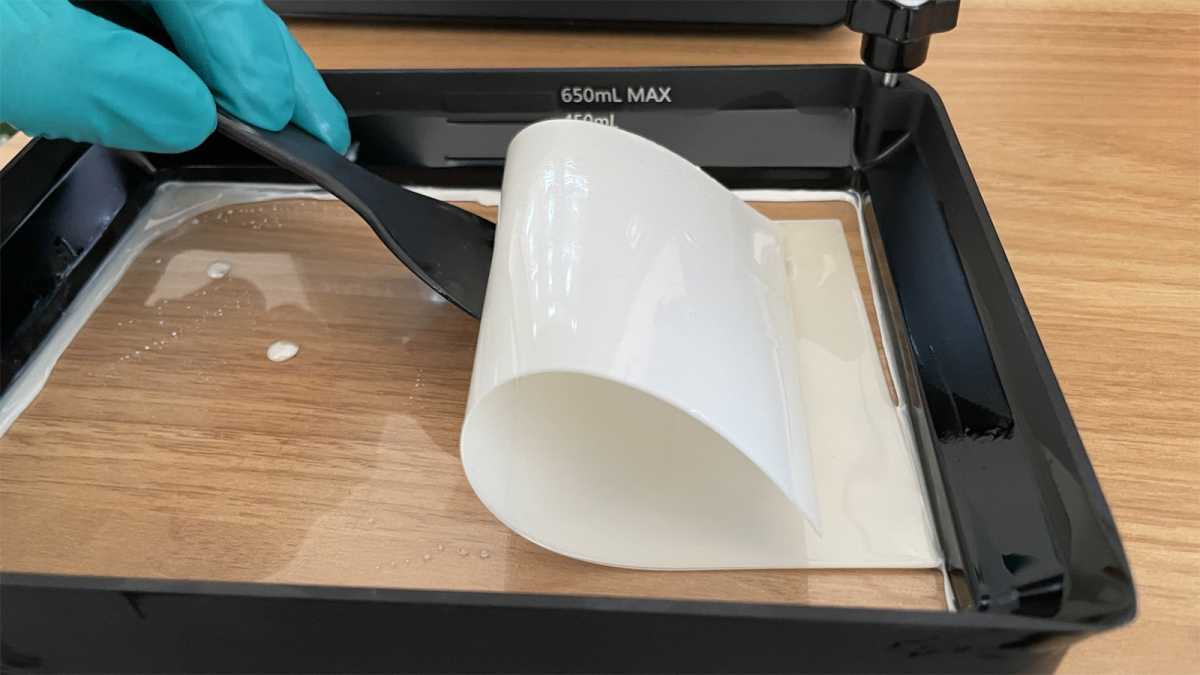
After printing, you can run a ‘cleaning’ cycle which cures an entire layer and should catch any small pieces which have fallen into the resin vat.
The default time of 25s wasn’t enough, so I ran it twice more and was then able to use the plastic scraper to remove the cured resin.
Jim Martin / Foundry
Price & availability
The Halot One Plus costs $399 from Creality’s website .
That’s $100 more than the similar Anycubic Photon M3. It isn’t identical: it touchscreen is smaller, it has a single linear Z rail and doesn’t have the Halot’s integral light source.
In the UK, availability is more limited than in the US. You can’t buy one from Creality’s website, and one of the only UK retailers listing it for sale at the time of review was Technology Outlet , where it cost £469.
For comparison, the Photon M3 costs £295, £174 less, making the Halot One Plus look overpriced. Hopefully this is because it’s brand new, and prices will come down when there’s better supply (and Creality sells direct to UK buyers, something that’s planned for the future).
Bottles of resin aren’t cheap. They’re sold by weight and a 1kg bottle costs $35-40. Creality sells both water-washable and standard resin, in a variety of colours.
Verdict
The Halot One Plus is a very good resin printer overall. In my testing, it performed reliably and delivered high-quality prints without fuss.
Like all resin printers, the process of removing supports, cleaning and curing after printing is a messy business, but there’s no way to avoid this unless you choose an FDM printer instead.
Aside from it being slightly noisier than I’d like, the main problem with the Halot One Plus is the price. It’s considerably more expensive than the Photon M3 and many first-time buyers will find it hard to justify spending the extra.
If you’re not a beginner care about getting the best-possible print quality, and really want the extra light uniformity of the Halot One Plus’ integral light source, you might be able to justify spending more.
Specs
- Print volume: 172 x 102 x 160 mm
- XY resolution: 4320 x 2560 (4K)
- XY accuracy/pixel size: 0.04 mm (40 μm)
- Print speed: 1-4s per layer (depending on the resin used)
- Z-accuracy / layer thickness: 0.01-0.2 mm
- Touchscreen: 4.9in color touchscreen
- UV light wavelength: 405 nm
- Power supply: 100-240 V 50/60Hz
- Power: 100W
- Size: 236 x 243 x 418 mm
- Weight: 6.9 kg
Best Prices Today: Creality Halot One Plus
Author: Jim Martin, Executive Editor, Tech Advisor

Jim has been testing and reviewing products for over 20 years. His main beats include VPN services and antivirus. He also covers smart home tech, mesh Wi-Fi and electric bikes.
Recent stories by Jim Martin:
- The best 3D printers 2024
- Creality K1C review
- Bambu A1 review
Just a few years ago, 3D printing was a hobby for geeks and nerds. It was difficult, frustrating and slow.
Fast forward to 2024, and that has all changed completely. Now, you can buy – for a very reasonable sum – a printer that works out of the box, doesn’t require hours of tweaking and adjusting and prints large models in hours – not days. Small models can take mere minutes.
Since you’re reading this, you’ve probably made it past the point of wondering what on earth you’d use a 3D printer for, but if not, there are many useful tools and gadgets as well as fun things to print, all of which are available to download free from sites such as Thingiverse and Printables .
Here we’ll explain what to look for in a 3D printer and recommend what you should buy.
First, a brief word on colour: consumer 3D printers are single-nozzle devices which print one colour at a time. If you want to multicolour prints, then Bambu’s P1S Combo and A1 Combo can hold four spools of filament and change colour automatically. Multicolour prints can take a long time, though, and waste filament.
One other thing: until you’ve spent time getting to grips with a 3D modelling app such as Fusion 360 or Tinkercad , you’ll be limited to printing objects that other people have designed. There are lots of them, but if you want something bespoke, you’ll have to create it yourself.
Don’t be put off buying a 3D printer, though. Choose wisely and you’ll be rewarded with a device that can print intricate, articulated models from the off.
We’re focusing mainly on FDM (fused deposition modelling) printers here because these are the most popular type. The other type is a resin 3D printer, such as the Creality Halot One Plus, which works very differently, and are designed for printing small, intricate, solid models.
Best 3D printers 2024
1. Bambu P1S – Best 3D printer for most people
Pros
- Excellent print quality
- Automatic colour changing
- Fast CoreXY motion system
Cons
- Basic non-touchscreen control panel
- Filament wastage can be high in multicolour printing
- No failed print detection
With so many tech products you get what you pay for. This inevitably means the “best” will also be the most expensive. It’s certainly the case here, but just because the P1S is expensive doesn’t mean it isn’t good value.
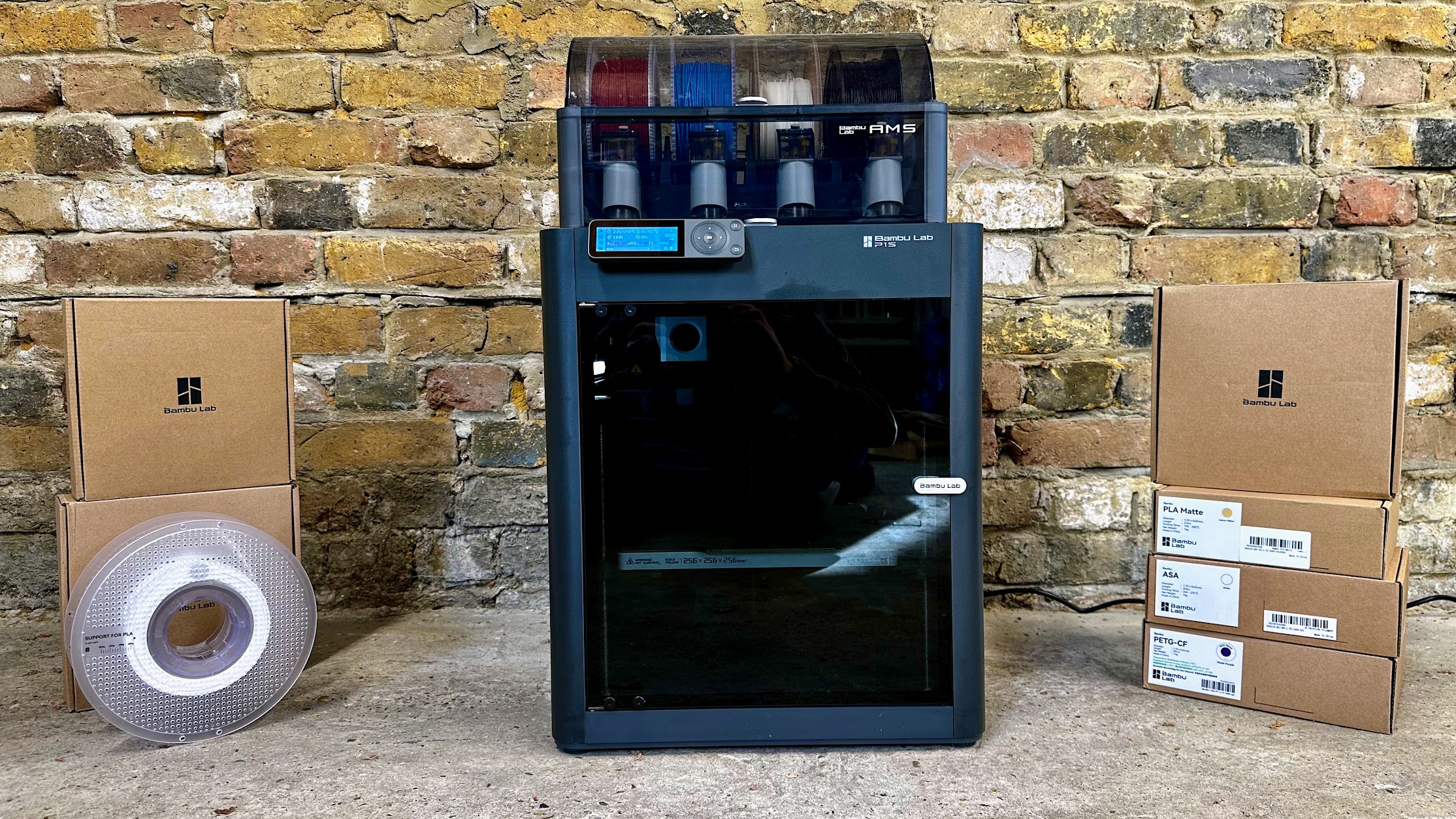
If you buy the P1S Combo, it will come with an AMS, a unit that sits on top of the printer. It holds four spools of filament and can load and unload them automatically and print in multiple colours without any assistance from you.
With only one nozzle, multicolour prints aren’t exactly fast. But the AMS also takes the pain out of changing filament when you want to print something in a different colour to the previous print.
If you don’t care about multicolour, you can buy the non-Combo version of the P1S for quite a bit less.
Overall, the P1S is a remarkably good printer. It’s really fast thanks to the use of a coreXY system, and as it’s fully enclosed it’s reliable even when printing with ASA, nylon, polycarbonate and other filament types because of the stable internal temperatures. More importantly, print quality is absolutely superb.
If there’s a downside, it’s the rubbish dot-matrix screen which seems very out of place on a printer this expensive. But, there are other ways to control the P1S, such as printing from a PC or phone via Wi-Fi. The Creality K1C is a good alternative if you must have a touchscreen, and it also has a few other features such as failed print detection.
If you just want to print with PLA, PETG and other filament types that don’t require an enclosure, take a look at Bambu’s A1 which is a lot cheaper.
Read our full Bambu P1S Combo review
2. Bambu A1 – Best budget 3D printer
Pros
- Fast, reliable printing
- Fully automatic levelling
- Excellent value
Cons
- Doesn’t support more exotic filament
- AMS Lite adds significantly to the price
In our full review, we call the A1 “the 3D printer you’ve been waiting for”, and with good reason. It’s as close to ‘one click’ printing as you’ll get right now: it adjusts itself automatically for reliable printing and has all the features most people want, at a surprisingly affordable price. Bambu’s desktop and mobile apps are really good, too.
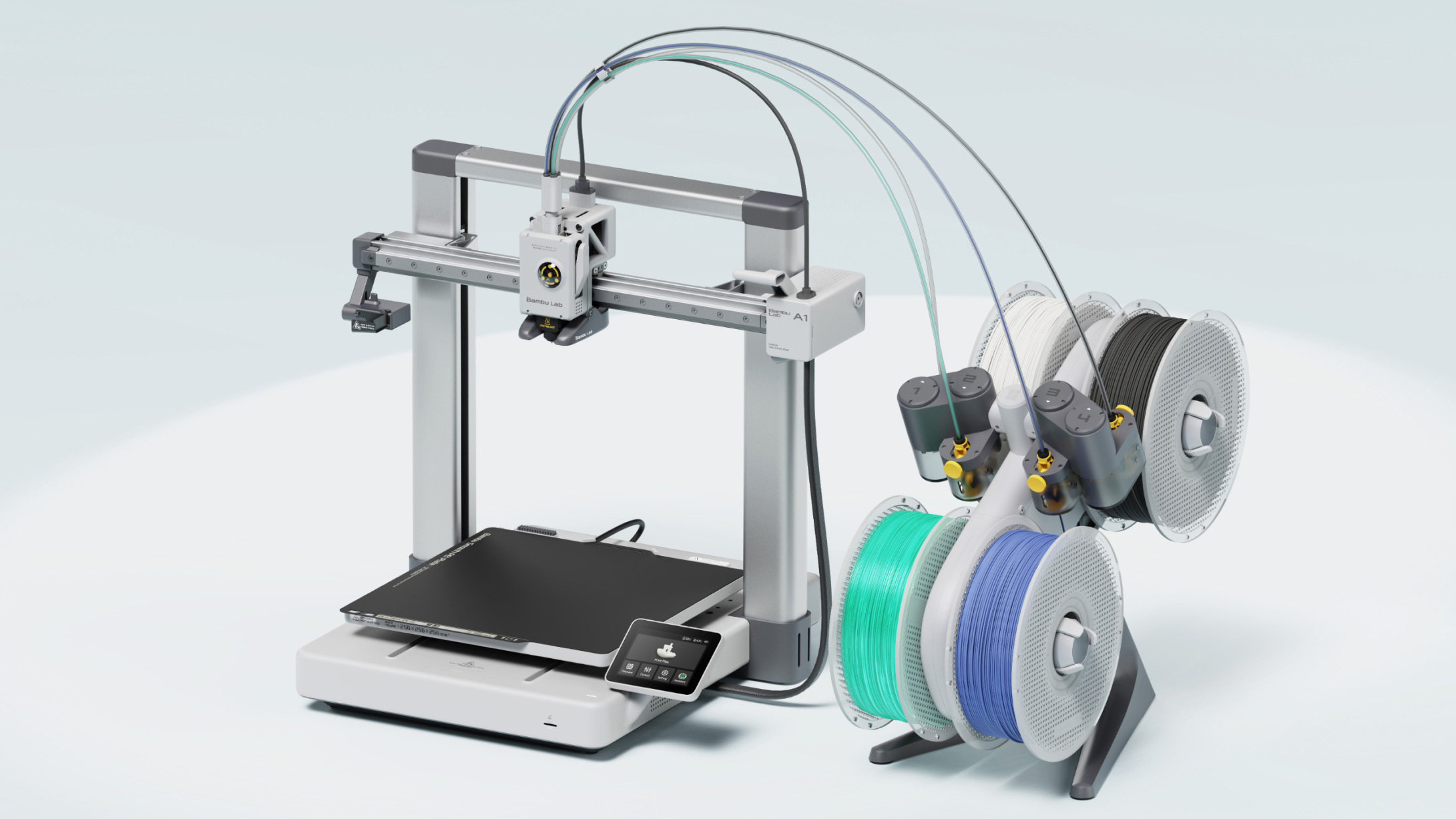
Like Bambu’s more expensive P1S, it can print models up to 256mm³ and you can buy the optional AMS Lite (shown to the right of the A1) for automatic multicolour printing.
The only drawback is that the A1 can’t really print nylon, ABS, ASA and other ‘exotic’ filaments because they require an enclosure. Without one, they tend to warp. The A1 can print carbon-fibre filaments if you buy Bambu’s hardened nozzle, which is very easy to fit.
Print quality, when using supported filament types, is sensational.
Read our full Bambu A1 review
3. Creality K1 Max – Best large 3D printer
Pros
- Fast, reliable printing
- Large build volume
- Fully automatic bed levelling
Cons
- Some features exclusive to Creality’s slicer
- No multi-colour capabilities
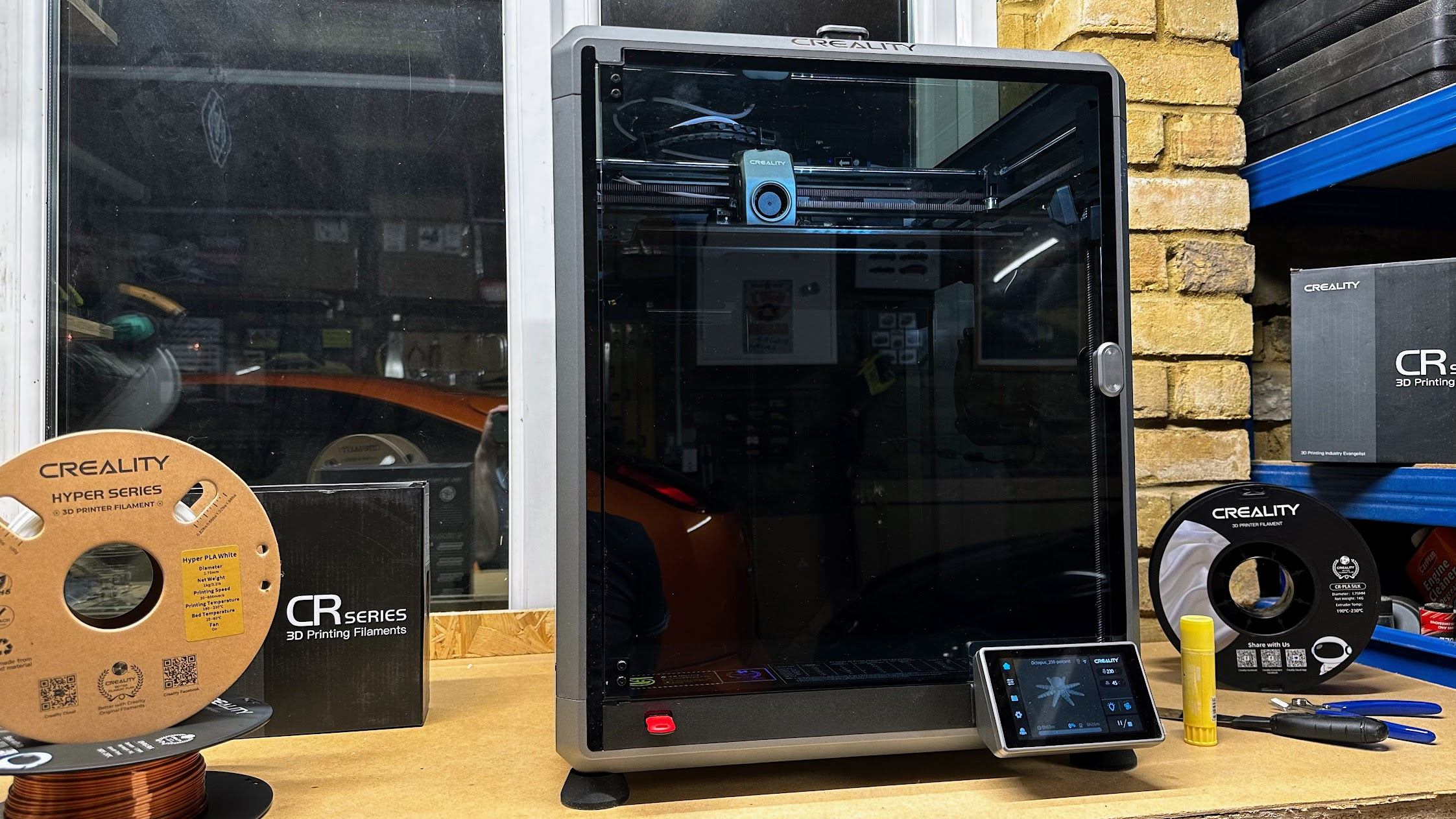
Some may say the K1 is just a poor copy of the Bambu P1S, but that does it a disservice when so many 3D printers are basically copies of each other. There are two models, the smaller K1 which is cheaper than the larger K1 Max.
The Max offers a 300x300x300 build volume, something not currently available from Bambu and it has an easy-to-use touchscreen. Bed levelling is fully automatic and it even has a LiDAR system that helps ensure prints are successful and good quality.
There’s built-in Wi-Fi and an ‘AI’ camera that can detect when prints are failing, as well as when you might have accidentally left a model or some tools on the build plate.
As both K1 and K1 Max use coreXY systems, they’re just as fast as the Bambu and although quality isn’t quite up to the P1S’s level, it’s still very good.
Read our full Creality K1 Max review
4. Elegoo Neptune 4 – Best cheap 3D printer
Pros
- Fast printing
- Automatic bed levelling
- Intuitive touchscreen controller
Cons
- No Wi-Fi
- More expensive in UK than US
- Elegoo’s slicer isn’t the best
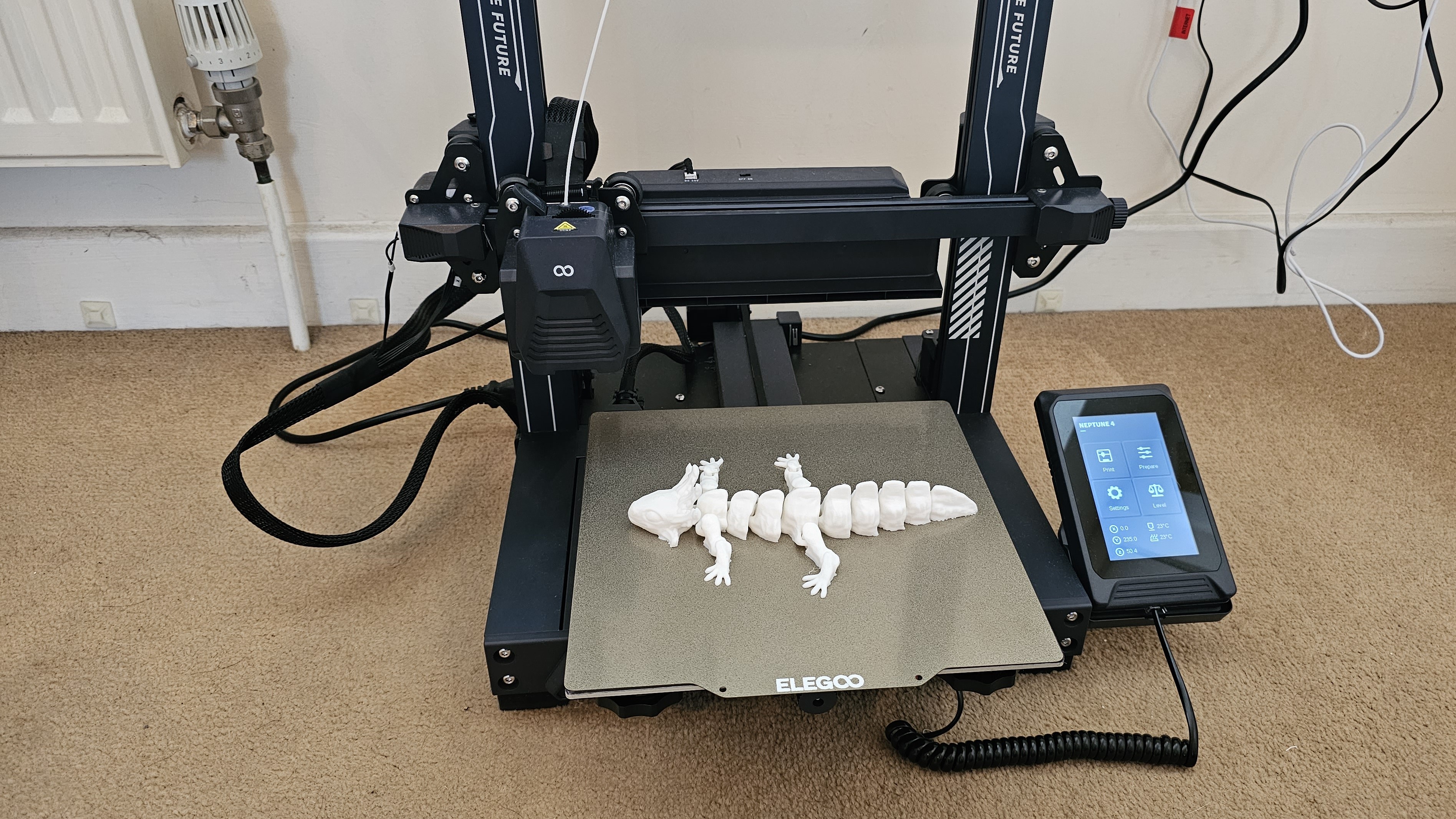
The Neptune 4 offers everything most people are looking for in a first 3D printer. It’s easy to set up, has auto bed levelling, a colour touchscreen and is pretty fast to boot.
That’s already a lot for the low price, so it’s not too surprising it doesn’t have Wi-Fi. Unlike some of the budget models here, it competes with the coreXY printers for speed thanks to an upgraded print head with much improved cooling over the Neptune 3.
It’s a shame that like the Ender 3 S1 Pro levelling isn’t completely automatic, but once you’ve adjusted the knobs, subsequent levelling is automatic.
Print quality is very good at the default 300mm speed, but it’s a good idea to use an alternative to Elegoo’s slicer which caused us quite a few headaches when prints failed.
Read our full Elegoo Neptune 4 review
5. Creality K1C – Best for exotic filaments
Pros
- Can print carbon fibre filaments out of the box
- Can print ASA, nylon, ABS as well as PLA and PETG
- Built in camera
Cons
- Single colour printing only
- Can be very noisy
- Frustrating to change filament
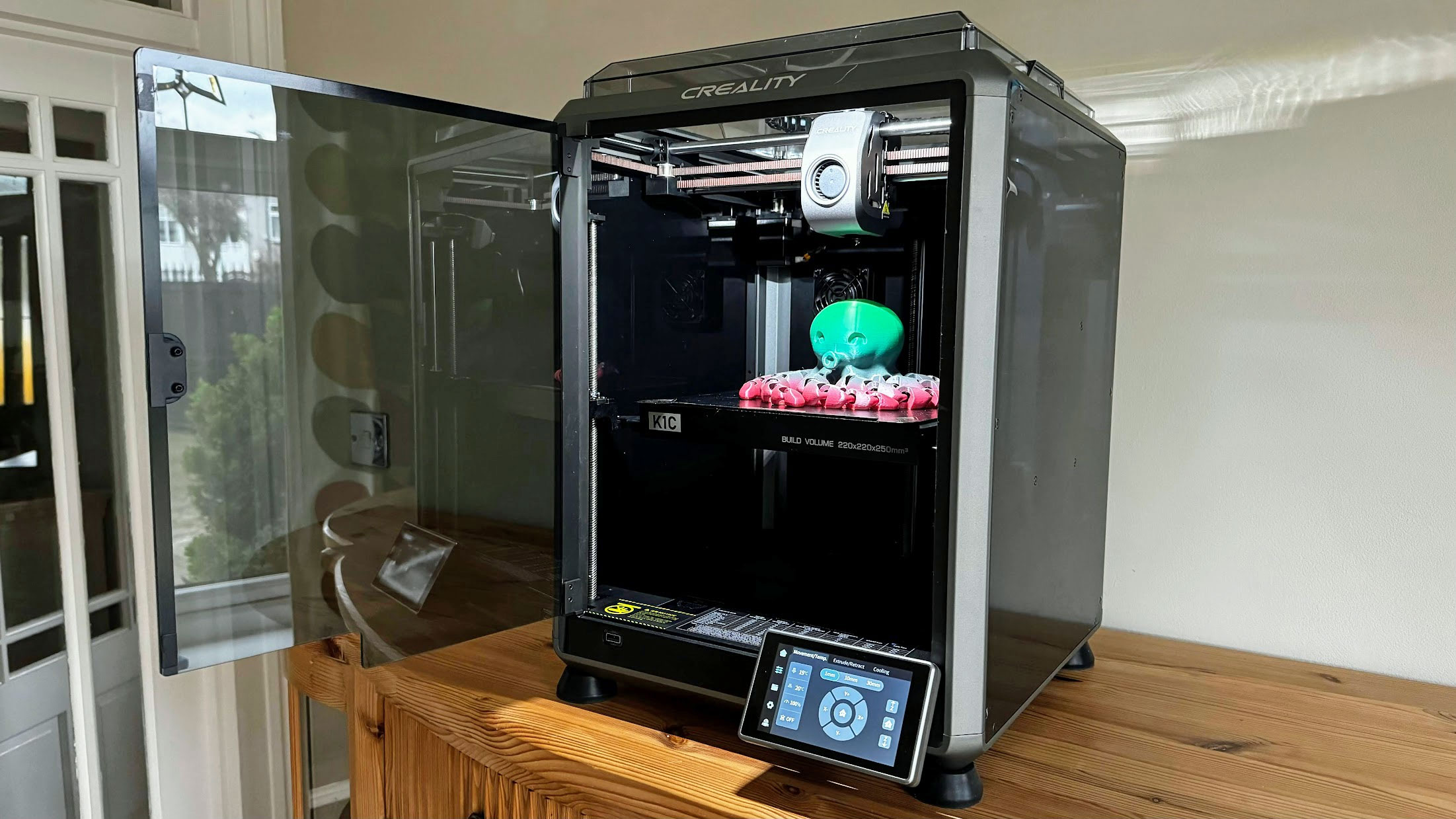
The K1C can print models up to 220x220x250mm, and comes almost fully assembled. It’s fully automatic, which means there’s no need to make any manual adjustments: it prints reliably from the word go.
Effectively, it’s an upgrade of Creality’s K1 and has a hardened steel nozzle that can print abrasive filaments like carbon-fibre infused PLA and PETG. Unlike the K1 it also has a camera for monitoring print progress remotely, and it’ll detect and notify you of problems like foreign objects left on the build plate and failed prints.
The touchscreen makes it easy to use, and Creality’s desktop and mobile apps aren’t bad, although they lack the polish and ease of use of Bambu’s.
The only real limitation is that the K1C can’t print in multiple colours, but if you don’t need to do that, it’s a great choice.
6. Anycubic Kobra 2 Plus – Best for printing huge models
Pros
- Massive build volume
- Fast
Cons
- Takes up a lot of space
- Not suitable for filaments which require an enclosure
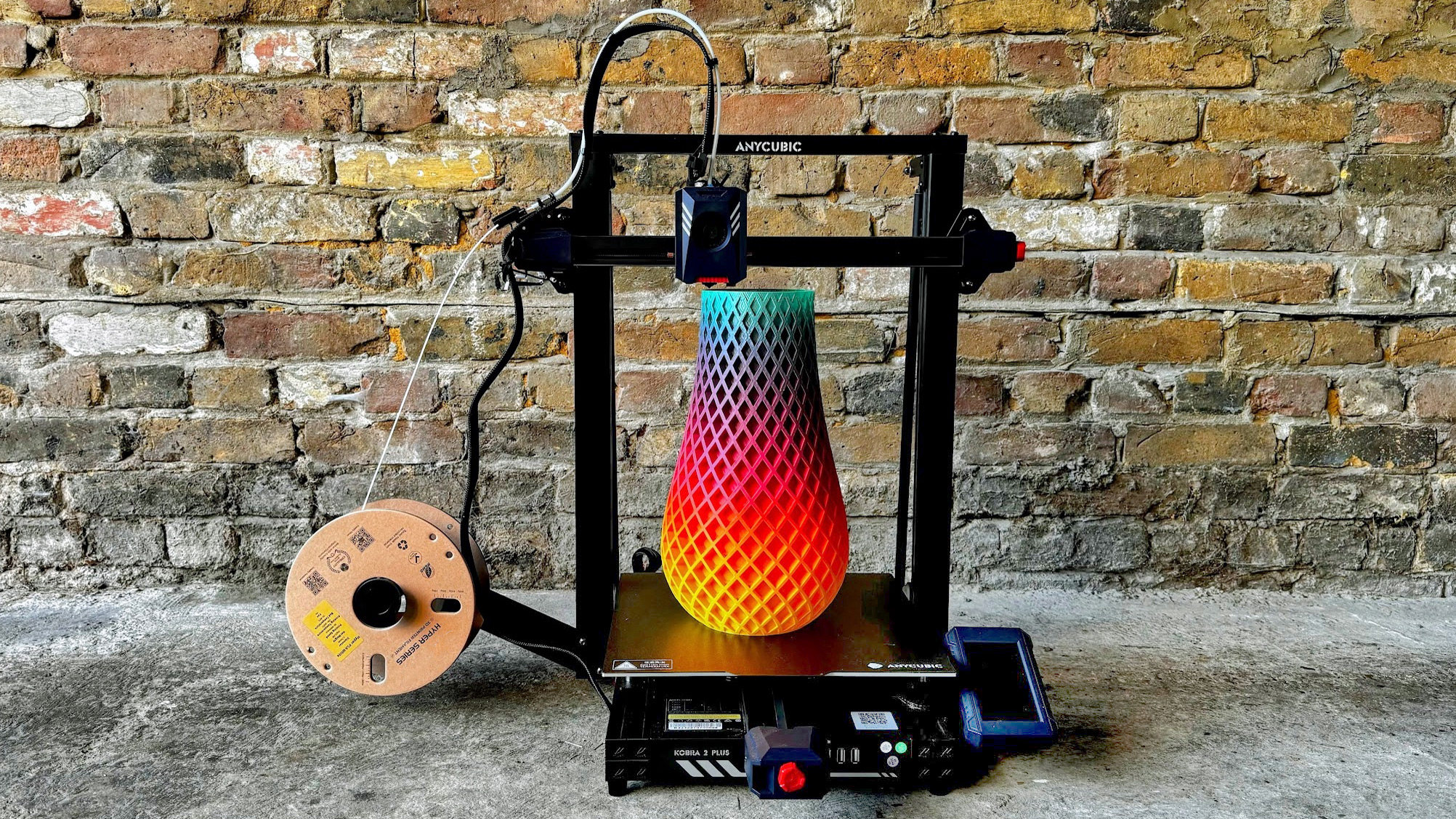
With a build volume of 320 x 320 x 400mm (WDH), the Kobra 2 Plus can print very large models. If that’s not enough, there’s also the Kobra 2 Max with an even larger 420 x 420 x 500mm volume.
It’s a bed slinger, which means the build plate moves backwards and forwards. In turn, this means you need quite a lot of desk space for the Kobra 2 Plus. It’s fast and capable of good print quality, and is pretty easy to use thanks to automatic bed levelling, vibration compensation and a colour touchscreen.
Read our full Anycubic Kobra 2 Plus review
7. Creality 3D Ender 3 S1 Pro
Pros
- Great print quality
- Almost all the features you’d want
Cons
- Auto-levelling requires manual input
- Slow by today’s standards
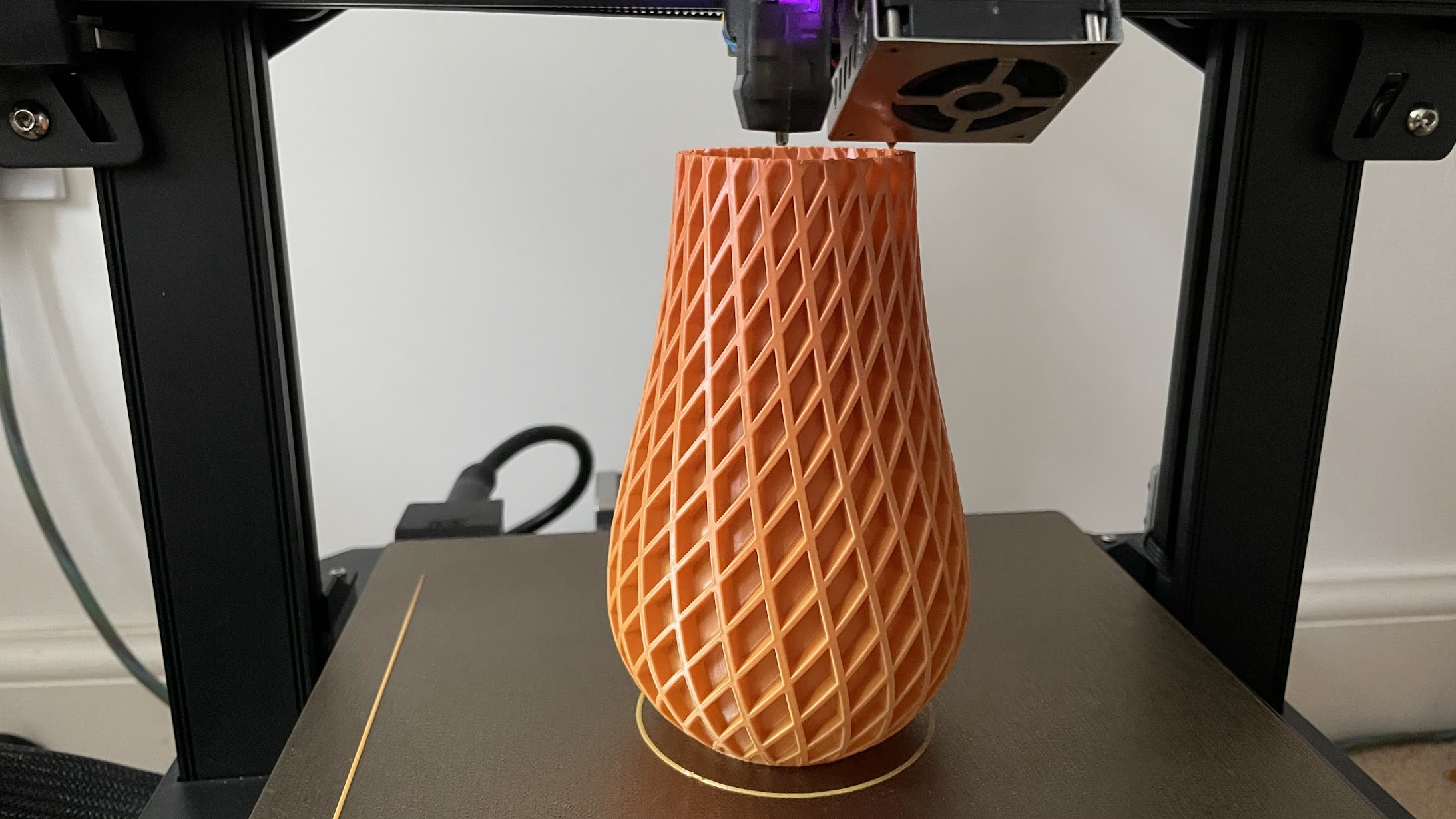
The S1 Pro is really a budget 3D printer but it’s more expensive than the cheapest because it has had all the bells and whistles thrown at it.
There’s the Sprite direct drive print head with dual metal gears for reliable extrusion. It’s capable of heating to 300C, so you can print with a wide range of filaments. The bed goes up to 110C, too, which helps prints adhere when working with more awkward types of filament.
It isn’t enclosed, though, and is a bed-slinger, so needs room in front and behind it to accommodate its range of travel. There’s a useful LED strip which is really bright, and a colour touchscreen. Its interface could be improved a bit, but it’s not bad.
Print quality is very good, but it isn’t fast. To improve it you can buy Creality’s Sonic Pad – a Klipper-based touchscreen – but this adds a lot of cost and hassle. If speed is important, choose a printer that offers 300mm/sec out of the box like the Bambu A1.
Read our full Creality 3D Ender 3 S1 Pro review
8. Creality Halot One Plus
Pros
- Easy to use & reliable
- Works with various slicers
- Great print quality
Cons
- Fan runs constantly during printing
- Requires post-printing cleanup + curing (like all resin printers)
- More expensive than some rivals
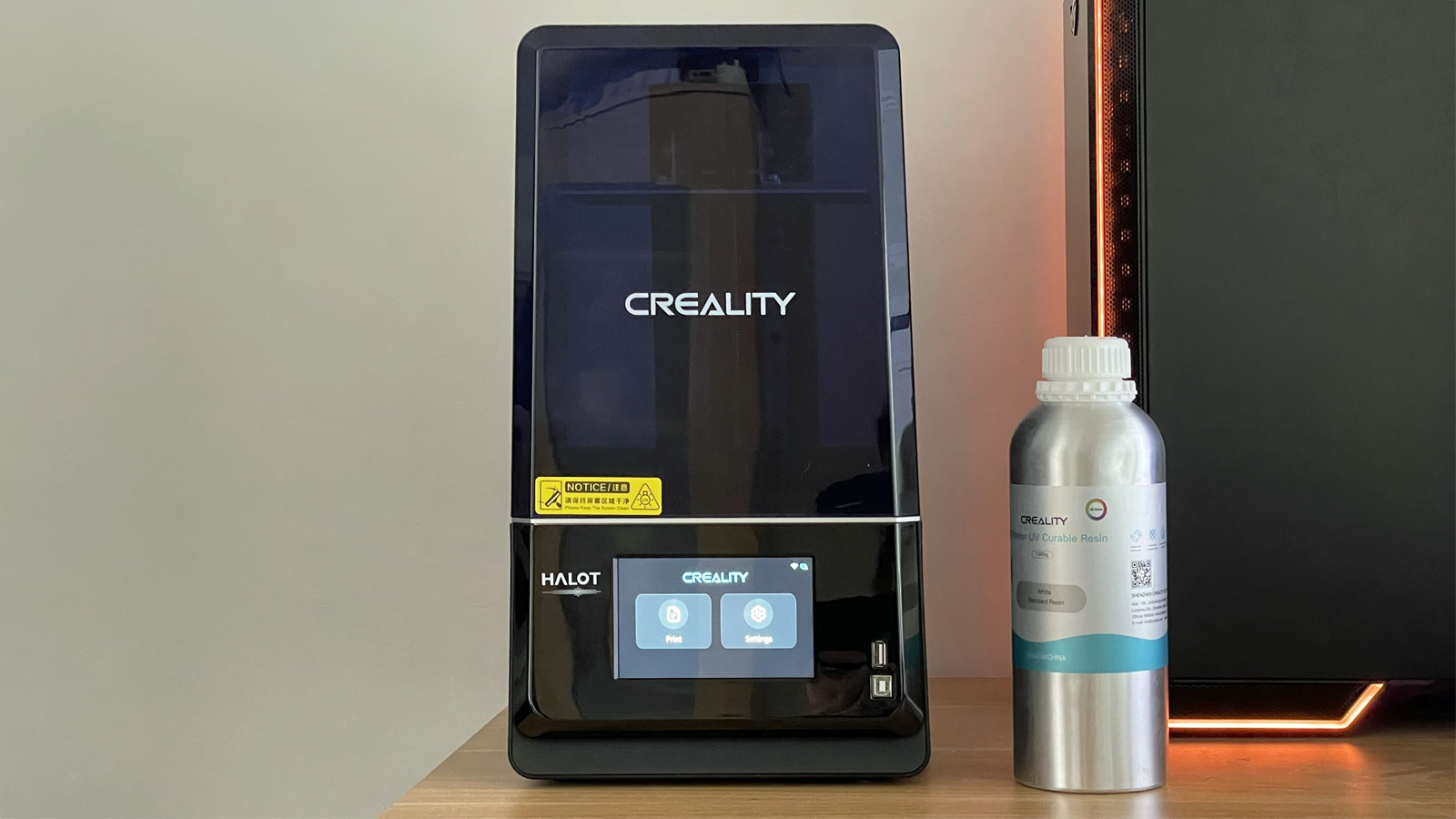
The Halot One Plus is an easy-to-use resin 3D printer that has a good-sized build volume, prints reliably and at high quality. It’s quite expensive compared to rivals, especially in the UK.
The Halot One Plus is a resin printer, so is very different to the others here. Instead of using filament on a reel, it prints using liquid resin which is cured, layer by layer, using UV light.
Build volume is smaller than the FDM printers here, but it’s still relatively large for a resin printer, and the screen’s high resolution means models have lots of fine detail.
The Halot One Plus printed ultra-reliably in our tests, but if you are keen on a resin printer, bear in mind that you have to clean up prints afterwards, which usually means buying a separate washing and curing device that looks a lot like a resin printer and takes up the same amount of desk space.
Read our full Creality Halot One Plus review
Buyer’s guide
Here are the key things you should look out for when choosing a 3D printer.
Automatic levelling
Unless the surface on which objects are printed is perfectly level, prints won’t stick to it and will fail sooner or later.
Manual levelling is a chore you could do without, so go for a printer with auto levelling. Be careful: some printers claim to have auto levelling, but rely on you to do a lot of the work. Which is why it pays to read reviews as well as knowing what to look for.
Heated bed
Almost all 3D printers have them, but it’s a must have. A heated bed will help prints to stick: don’t buy a printer without one.
PEI sheet
Models can be difficult to remove from the build plate. A PEI (polyetherimide) sheet helps immensely. It’s a flexible metal sheet with a textured coating is used, and held in place with magnets. When the model finishes printing, you simply lift the sheet off, flex it and the model pops off.
Touchscreen
Some printers still use a monochrome screen with a rotary dial or buttons. This isn’t nearly as easy to use as a touchscreen. Bambu P1S (and P1P) would be much better with a touchscreen, but it’s not the end of the world with those as you can print from your PC or phone using Bambu’s apps. When a printer doesn’t have Wi-Fi (or any networking) you are stuck using the screen it comes with.
Build volume
A printer’s build volume tells you how big an object it can print. It’s wise to assume that the actual maximum volume is a bit smaller than the specifications suggest, and go for one with a slightly larger volume than the biggest object you will need to print.
It can be hard to know this, and remember that a bigger volume means a bigger printer, which you’ll need space for.
Really large models can be printed in sections and superglued (or otherwise fixed) together, so you don’t necessarily need a huge printer.
Nozzle and bed temperatures
Most people print using PLA, the most common type of filament. It’s easy to work with, strong and durable.
All 3D printers have nozzles that go up to the 220°C or so that PLA requires. But if you want to print with ABS, PETG or another type that needs high temperatures, be sure to opt for a printer that can go up to around 300°C. But see Enclosure below, too.
Similarly, watch out for heated bed temperatures. Some won’t go beyond 80°C, but you’ll need 100°C or more for successful ABS prints.
Enclosure
Some materials such as ABS, ASA, polycarbonate and nylon need carefully controlled ambient temperature to prevent them from warping while printing. If you need to use these – perhaps because you want to print models that can survive exposure to sunlight, then look for an enclosed printer – essentially a self-contained box.
Run-out sensor
With large models taking many hours to print and the fact that you can’t always know if there’s enough filament left on the reel to complete it, a run-out sensor can be a life saver. It does it what it says: detects when the filament runs out and halts printing automatically, allowing you to load a new reel and carry on printing.
Without one, the filament could run out and the printer will carry on printing thin air, and you’d be none the wiser.
What’s the best 3D printer for beginners
The Bambu A1 is an excellent choice for beginners. It’s relatively affordable and is very easy to use because it handles so many things automatically. It’s also fast and offers top notch print quality.
How much does a beginner 3D printer cost?
Printers start from as little as $130 / £130, but you may want to spend more to get a better model with more features, faster speeds and better print quality. There are a lot of great printers under $500 / £500.
What type of 3D printer is best?
The most common type is FDM (printers that use filament on a spool), but the absolute best quality is from SLA printers, which use resin and are capable of printing much finer detail. There are lots of pros and cons of each type, but put simply, resin printers are best for small, intricate figurines, while filament printers are best for printing things that are useful around the home as well as models that hinge or articulate.
Is it cheap to use a 3D printer?
Spools of filament typically weigh 1kg and cost from $15 / £15 to $30 / £30. It’s therefore the weight of the model that matters most, not the size. So-called slicing software turns a 3D model into instructions a 3D printer can understand, and you can adjust the settings to save weight by minimising the amount of infill. Sometimes it’s cheaper to print your own parts, but sometimes you might find it’s cheaper to buy pre-made plastic things than to 3D print them.
Are 3D printers good for beginners?
3D printing is much easier than it used to be thanks to modern printers that automate a lot of the fiddly things like bed levelling. They can also compensate for vibrations, resume printing after a power cut or when the filament runs out. The difficult part is designing your own models to print, but there are thousands of pre-made models available online to download free.
Author: Jim Martin, Executive Editor, Tech Advisor
Jim has been testing and reviewing products for over 20 years. His main beats include VPN services and antivirus. He also covers smart home tech, mesh Wi-Fi and electric bikes.
Recent stories by Jim Martin:
- Creality K1C review
- Bambu A1 review
- Bambu A1: a full-size bed slinger 3D printer
