Google Pixel smartphones are popular. They’re not only technically impressive, but they’re also the first to benefit from new Android versions (although this isn’t always an advantage, as our Mobile Editor discovered ). There’s one country, however, in which Pixel devices are best avoided, as carrying one can cause you to be targeted by the police.
In Spain, specifically in the popular holiday region of Catalonia, police officers are on the lookout for people who use a Pixel smartphone, as these devices are favoured by criminals, drug dealers and gangs.
It’s even the case that the police may automatically assume that someone is likely to be smuggling drugs if they’re using such a device, as reported by the Spanish website Xataka Android , among others. But it has less to do with the phone itself and more to do with the operating system.
Why are Pixel devices popular among criminals?
In Catalonia, an autonomous region within Spain, criminals prefer to use Google Pixel devices to communicate with each other. The Pixel 8 series and Pixel 9 series are said to be particularly popular.
The gangs specifically use these devices in conjunction with open-source GrapheneOS, an alternative operating system which can be installed on Android phones, which places particular emphasis on data protection and security. Data is encrypted on the device and can’t be accessed by Google. In addition, tracking by apps is considerably restricted.
This is a major advantage for drug dealers and gang members. Even if the authorities catch a gang member and seize their device, they face considerable problems cracking it and can’t easily access contacts and information stored on it. This seriously slows down investigations.
GrapheneOS is particularly compatible with Pixel smartphones, and the phones have other advantages as they’re equipped with powerful hardware and are easy to modify. According to reports, criminals often remove components such as the camera, microphone or GPS chips to be on the safe side, before using the devices.
In addition, most dealers refrain from unlocking their phones using biometric methods, ie by fingerprint or face ID. Otherwise, the police could force them to open their devices. This is legally permitted in Germany, as our sibling publication PC Welt reported.
GrapheneOS also gives you the option of setting up an emergency PIN that won’t unlock the device, but instead deletes all data. So if the police try to force a user to unlock the device with a PIN, it gives them the opportunity to wipe their phone completely. Even if the code is entered incorrectly several times, all data will be deleted.
How the manufacturer has responded
Google has not yet responded to reports that Pixel devices offer particular advantages to criminals. However, the operators of GrapheneOS have responded on X (formerly Twitter), stating that they reject the misrepresentation by “authoritarians”. They contend that Pixel devices with GrapheneOS are not just for criminals, and state that they are firmly opposed to “mass surveillance”.
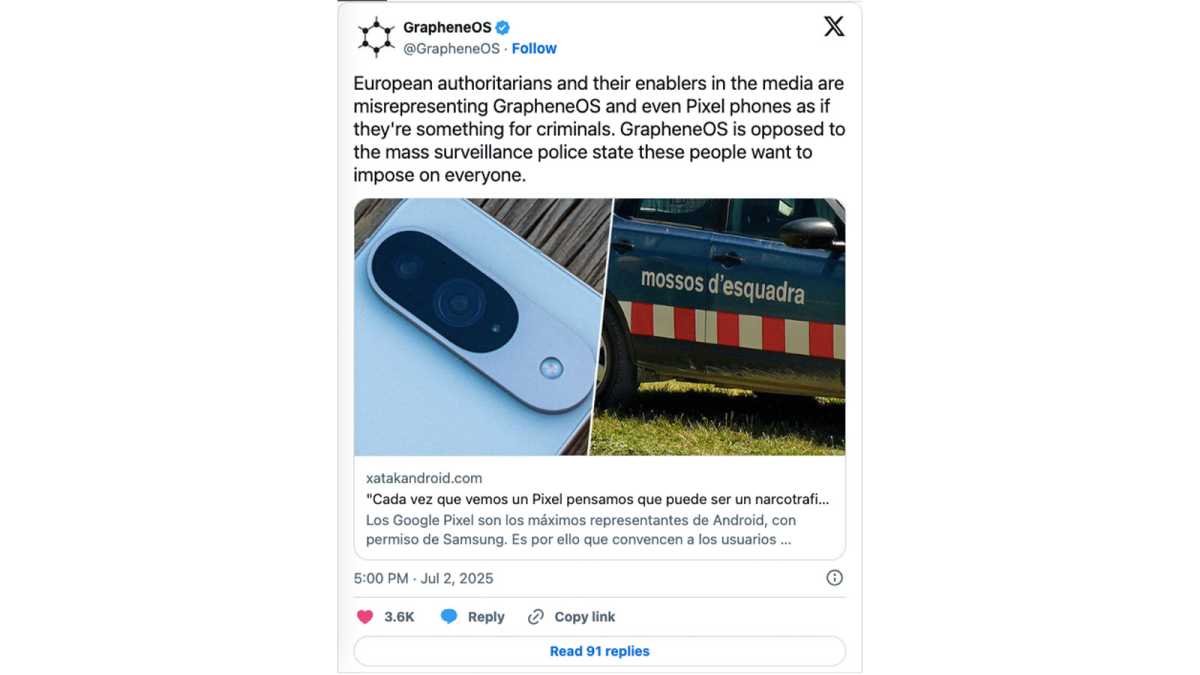
X
Incidentally, the police response is to infect suspects’ smartphones with malware to gain access to their data. However, this doesn’t always work as planned, as they first need to put devices into UEFI mode. With GrapheneOS, however, phones are automatically rebooted every 18 hours, which can lock out authorities.
What you should do
Anyone travelling to Catalonia with a Pixel phone shouldn’t expect to be arrested on the spot. However, police keep a close eye on those who use Pixel devices to make calls or texts in public and can take them in for questioning on suspicion of illegal activities.
You should therefore be particularly careful if you own such a device and are planning to spend your next holiday in Catalonia. Perhaps think about buying a cheap second phone or leaving your smartphone in your pocket when in public – especially if you have GrapheneOS installed on it.
Google Pixel 9a price comparison

This article originally appeared on our sister publication PC-WELT and was translated and adapted from German.
Author: Laura Pippig, Staff Writer, PC-WELT

Laura is an enthusiastic gamer as well as a movie and TV fan. After studying communication science, she went straight into a job at PCMagazin and Connect Living. Since then, she has been writing about everything to do with PCs and technology topics, and has been a permanent editor at our German sister site PC-WELT since May 2024.
Recent stories by Laura Pippig:
- WhatsApp gives users a choice: Pay money or see adverts
- Your phone is covertly sharing your data at night! How to stop it
- Samsung launches surprise update for older Galaxy smartphones
