At a glance
Expert’s Rating
Pros
- Can be wall-mounted
- App or remote control
- More stylish than similar models
Cons
- No carry handle
- Bulky to move around
- Control buttons not intuitive to use
Our Verdict
If you want to be cosy and chic, Duux’s Edge 1000 Smart Convector Heater is one to choose. It’s packed with handy features – including smart ones – so you can heat a space to degree-perfect warmth, and looks great while it’s doing so. The main snags are the less-than-intuitive controls and the price tag.
Best Prices Today: Duux Edge 1000 Smart Convector Heater

Convector heaters are good for a few things: heating less frequently used spaces, keeping damp at bay, and warming up individual rooms when you don’t want to switch on the central heating – although you’ll still need to keep an eye on running costs. However, many of them are also less than lovely to look at, and without a timer plug, need to be turned on manually.
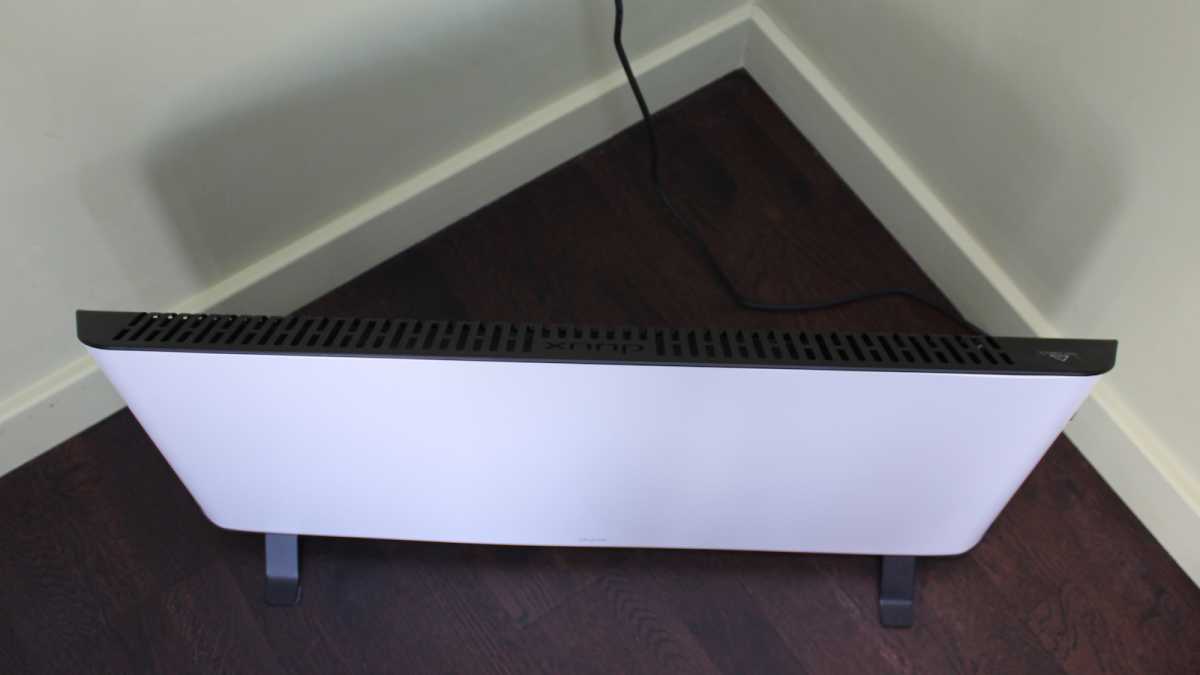
Duux’s Edge 1000 Smart Convector Heater is decidedly different. For starters, it may just be the most stylish convector heater around, thanks to its curved corners, LED display, and smooth matt finish. Then there’s its smart capability – allowing you to set modes, timers, ideal temperatures and more.
And if you don’t want to rely on your smartphone, there’s even a handy remote – ideal for nudging the heat up or down or flicking it into night mode before drifting off to sleep.
Design & Build
- Wall-mounted or freestanding
- LED display
- On-appliance controls, remote and smart controls
If you’ve ever used a basic convector heater – often boxy and clunky – then the Duux Edge 1000 will be a breath of fresh air aesthetically. It’s the opposite: sleek lines and curved corners, with slim aluminium feet if it’s on the floor and no feet if you’re wall-mounting it.
It’s larger than most budget models too, measuring 81cm wide and 40cm tall. It does, however, have a slim depth of just 6.5cm, meaning that it doesn’t take up much space when flat against a wall. What it is missing is a handle for carrying it from room to room if required: its weight of 7.55kg and width make it an awkward load.
Rachel Ogden / Foundry
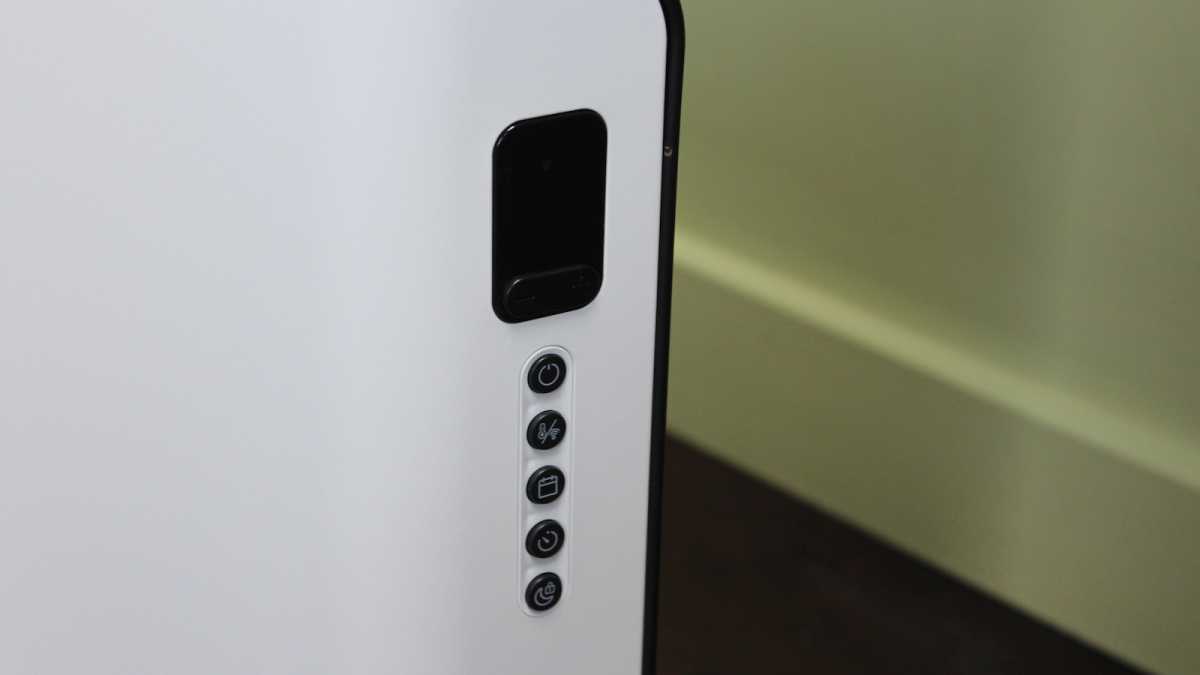
Its controls are minimal – there’s a small LED display with five buttons below to turn it on and off, adjust the temperature, set a timer and child lock/night mode (for a reduced display with half the brightness), plus a rocker for toggling settings up and down. These buttons are all repeated on its remote control.
While what each button does is apparent, using them to achieve the setting or mode you want isn’t always straightforward. We found it necessary to keep the instructions to hand throughout testing as setting schedules and overwriting them, or timers, could be tricky without.
Rachel Ogden / Foundry
Performance & Features
- Misaligned screw holes on review sample
- App layout confusing
- IP24 rating
While the heater can be wall-mounted (mounting bracket, screws and rawlplugs are provided), we chose to attach the feet. Unfortunately, misaligned holes on one pair of the feet meant that only one screw could be inserted to secure it, not two. This meant that our sample had a bit of a wobble when moved around.
Our next challenge was the app: there’s more than one for Duux. Having downloaded the right one, and after a couple of attempts (it’s only compatible with 2.4, not 5GHz), we finally connected it to our Wi-Fi.
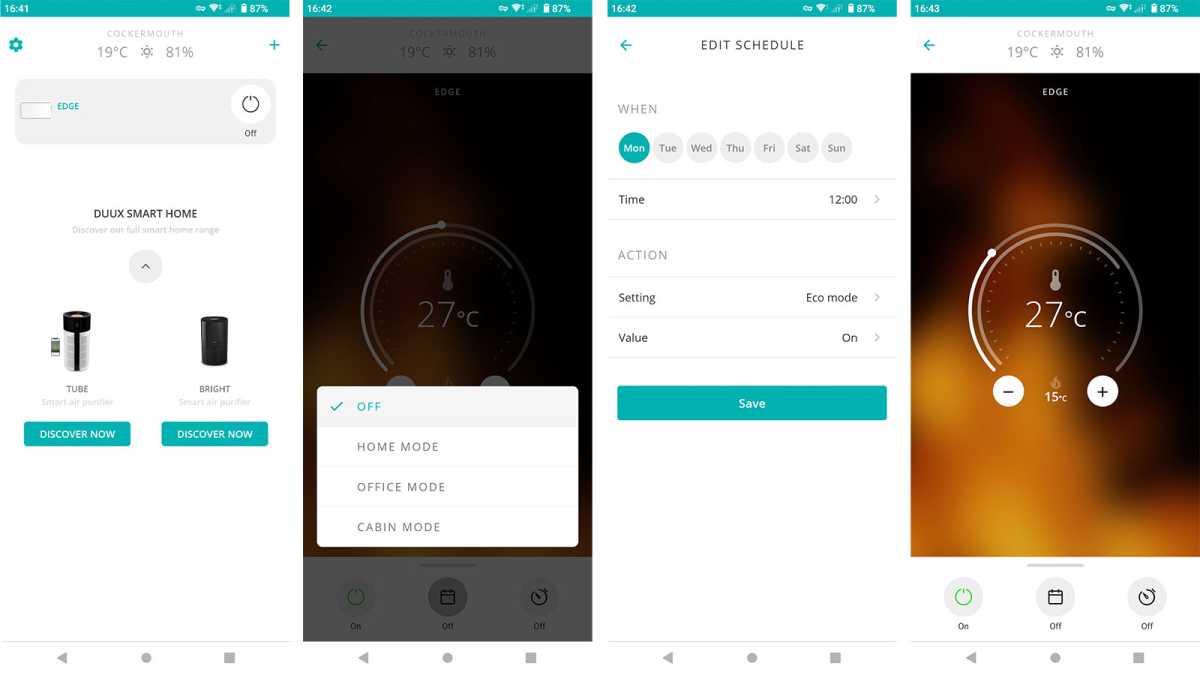
The app itself isn’t that intuitive to use: for example, to turn the heater on from its home screen, you have to press the ‘off’ button, and hit the ‘on’ to turn it off. Modes (presets for Home, Office and Cabin) are hidden under another button marked ‘off’, as is a countdown timer.
Other modes (Eco, Night) and child lock have to pulled up from the bottom of the screen. And it’s worth bearing in mind that most of what the app offers is on the remote control, except the Eco mode, and voice control (if you have a compatible smart speaker).
Possibly the app’s most useful function is the ability to create ‘rooms’ if you have other Duux appliances, such as a dehumidifier. This means you can group them together for a room, and turn them all on or off quickly.
The app also makes setting schedules for different days of the week easier than using the remote or buttons on the heater. We found the remote a handy tool to have – but you will need to be in sight of the heater for it to work. If not, the app is more reliable for making temperature adjustments.
Rachel Ogden / Foundry
Control issues aside, what the heater does do well is warm a space quickly, and keep it at the right temperature. It packs in 1,000W of power to do so, and starts warming up from the moment it’s switched on. This means it’s great for small to medium-sized spaces – our test area was 15sq m, which is around the maximum area this heater suits.
It also includes overheat protection, a temperature range of 5-36 ° C (the lower one making it good for spaces you don’t want to drop below freezing, such as conservatories or orangeries), IP24 rating (so you can leave it somewhere damp, such as a garage) and a tip-over switch that’ll turn it off if it falls over. A final handy feature is open window detection, which will stop heating if it detects a sudden drop in temperature.
You’ll need to bear its running cost in mind when using it. Plug-in heaters are cheap to run in short bursts, but the cost can quickly escalate if you leave one on for hours every day. As a rough guide, a 1,000W appliance will cost around 27p per hour to run on an electricity tariff based on the current October 2023 price cap. You can use an online electricity cost calculator to personalise it to your electricity tariff. But this will only give you a rough estimate, as it’ll also depend on the heater’s settings.
The most accurate way to find out what this heater – or any plug-in appliance – costs to run, and to keep an eye on its power consumption, is to use it with a smart plug with an energy tracking feature. You can find options in our round-up of the best smart plugs we’ve tested.
Price & Availability
But its price is a bit of a sticking point. You can buy smart heaters with a similar feature set and power output for less. We’ve reviewed two excellent smart glass panel heaters – from Devola ( see our review ) and Princess ( read our review ) – that are available for around £110.
There are more options in our round up of the best plug-in heaters we’ve tested.
Should you buy the Duux Edge 1000 heater?
Once you’ve got to grips with its quirks and multiple buttons, the Duux Edge 1000 Smart Convector Heater is likely to be an incredibly handy bit of kit for warming spaces without central heating, or those that are infrequently used. Being able to control it from afar has advantages, as does the ability to set a heating schedule, which is something you won’t find on cheaper models.
Plus, if you use it for heating an office for home working without heating your whole house, or boosting the heat in a bedroom before sleep, it could even be an economical energy saver.
However, its good looks and extra features come at a price. Most cheaper convector heaters can be picked up for around £30-50, allowing you to buy three or four of those for the same money, plus they tend to offer more wattage (up to around 2-3kW) for heating. Whether or not Duux’s Edge 1000 Smart Convector Heater is a better buy will come down to how much you need its smart capabilities, or how much you warm to its sleek aesthetic.
Not the perfect heater for you? Have a look at our round-up of the best portable heaters we’ve tested.
Best Prices Today: Duux Edge 1000 Smart Convector Heater
Author: Rachel Ogden, Contributor, Tech Advisor

Rachel Ogden specialises in reviews of home appliances, from kitchen gadgets to smart home tech. She’s a UK-based freelance journalist with more than 24 years’ experience and has written for publications including Ideal Home, BBC Good Food, The Sunday Telegraph and The Evening Standard.
