
At a glance
Expert’s Rating
Pros
- Low cost per page
- Cheap within EcoTank range
- Excellent print quality
- Sublimation possibilities
Cons
- Flimsy build
- Won’t print A4 borderless
- One year warranty
Our Verdict
The relatively low cost of this ink tank printer is reflected in its flimsy Construction, but it prints very well, and the cost per page is meagre. It also has potential for those wanting to explore sublimation printing on a tight budget.
Best Prices Today: Epson EcoTank ET-1810
Epson has made the EcoTank printer the hardware to own, as it addresses the annoying inkjet issue of the diabolically expensive ink cartridges.
The snag for any printer maker is that ink tank designs need to be more expensive to get some of the money back that they made previously on cartridges, increasing the purchasing cost of the printers.
That initial high price puts off many customers who want that low-cost-per-page goodness that EcoTank designs deliver but without paying up front.
One possible answer is the Epson EcoTank ET-1810, its cheapest colour model yet. Here the functionality of the machine has been boiled down to only printing but delivered at a price range home users can afford.
Low-cost devices are generally about compromise, so is the ET-1810 enough EcoTank to make it worth the investment?
Design & Build
- Basic printer design
- Lightweight but flimsy
- Four ink tanks
- No ADF on top
To make the ET-1810 affordable, some things common to its more expensive brethren had to go. Therefore, this is exclusively a printer, with no scanner, copying, Fax or coffee maker inbuilt. The more expensive EcoTank ET-3850 has some of those features.
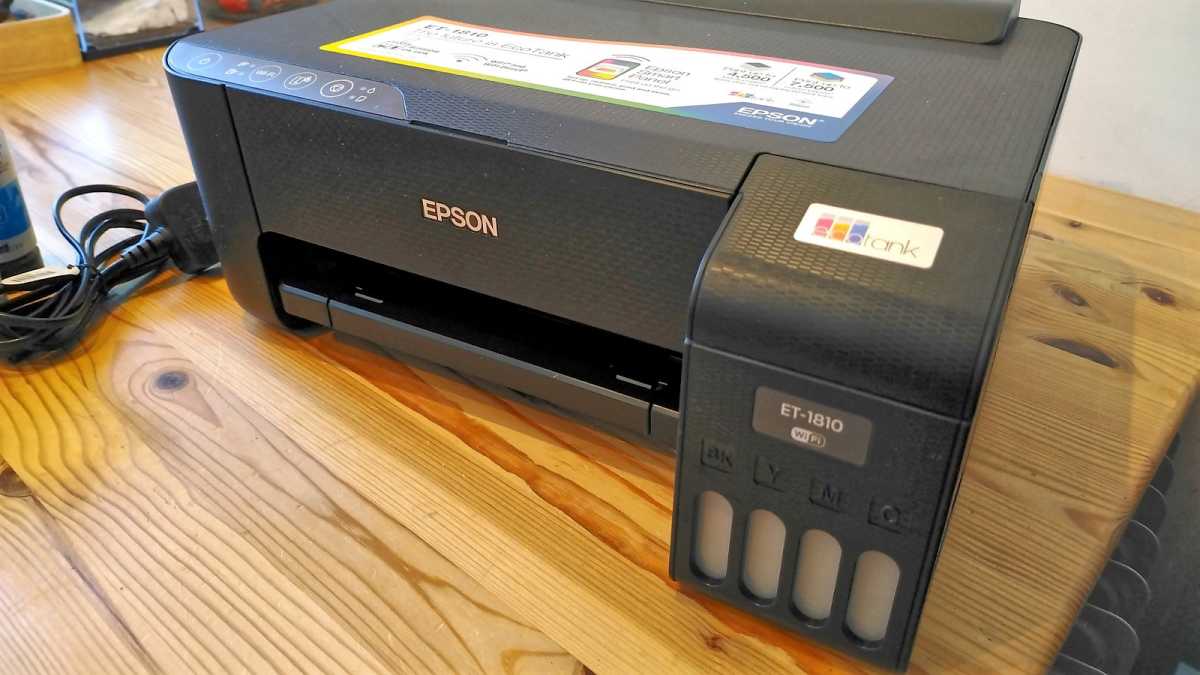
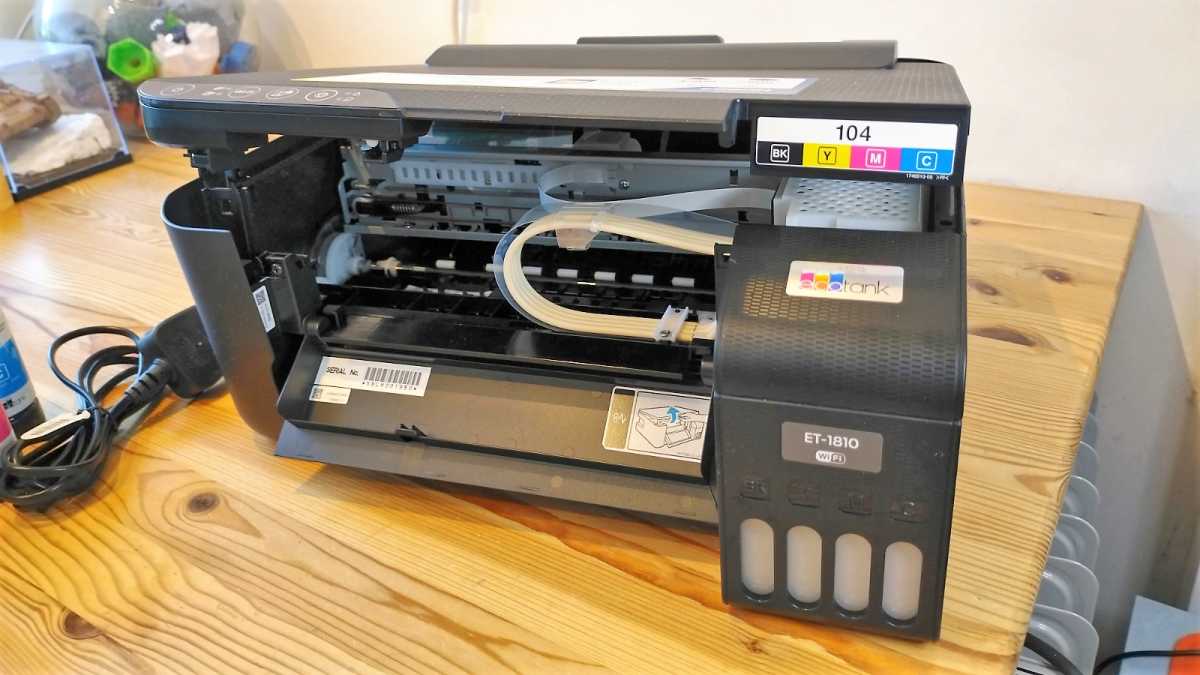
Once removed from the box, the design of the ET-1810 suggests, possibly wrongly, that the mechanics of this printer were once a cartridge design where EcoTank technology was an afterthought. The odd extension to the case on the right indicates that when the internals were designed, no ergonomic consideration for the ink tanks was made.
Not that this is a big issue, but it’s a curious design aspect of the ET-1810 and its ET-2810 stablemate.
Mark Pickavance
Another striking aspect of this design is its lightweight, at just 2.9kg. Its primarily plastic construction is best described as minimalist, though I’d also accept the word ‘flimsy’. The low weight makes it easy to relocate, but it doesn’t send positive messages about how much abuse this hardware might take before failing.
Printers don’t tend to be subjected to much though and in all other respects, this is a by-the-numbers inkjet printer, with a direct paper path from the rear to the front and a holding capacity of just 100 sheets.
With no display, the only indicators are the LED light around the power button and the semi-transparent ink tanks that reveal how much ink is left. On the rear are the power inlet and USB connection for a computer. But with WiFi included, the machine can be widely networked easily.
Set Up, Apps & Wireless Printing
- Epson Smart app
- Included ink
- Wi-Fi and USB
Without a display on this printer’s control panel, the only way to configure this machine is to connect it to a computer or a mobile device using Wi-Fi.
Using the Epson Smart application on a mobile device (iOS or Android), it doesn’t take long to configure the ET-1810 for a Wi-Fi connection. Once complete, you can print directly from a phone or tablet using WiFi Direct, even if there is no wireless network.
Feedback on the machine is limited to LED indicators on the front left edge but the Epson Smart app gives you more information. For those not wanting to network, it also accepts a USB cable. Epson has not included the standard Type-A to Type-B cable needed, so you will need to supply your own. It may, possibly not unreasonably, assume that you might have one spare from all the other USB printers you might have owned over the years.
Mark Pickavance
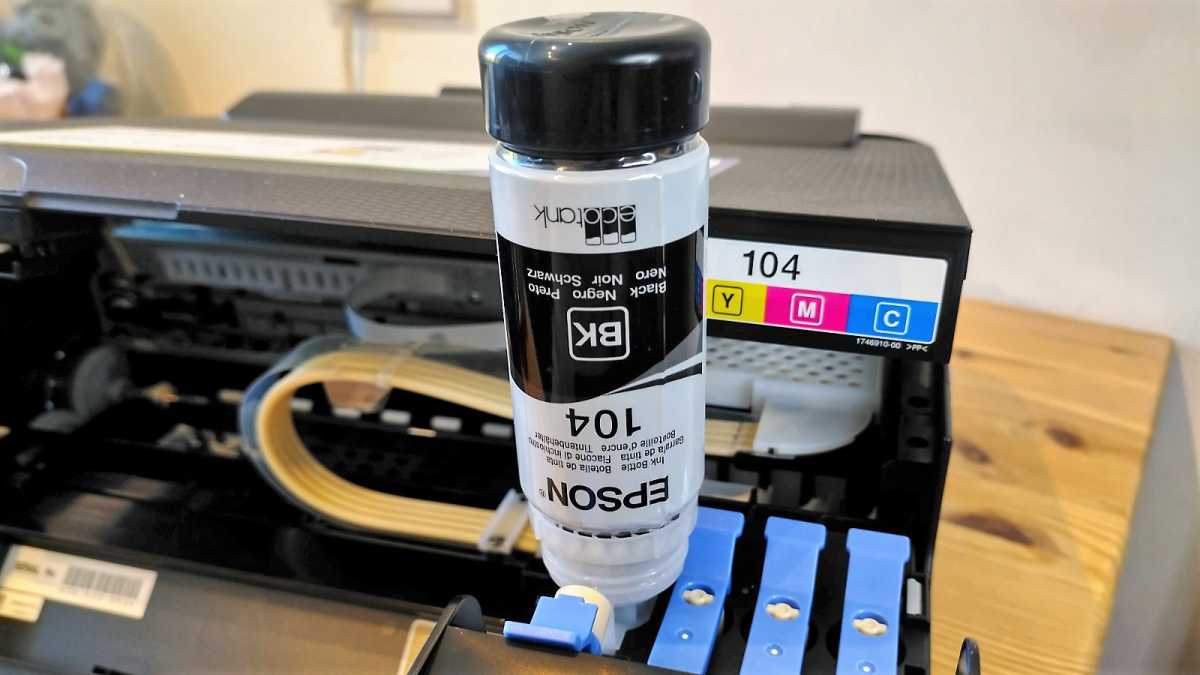
Ink installation is remarkably straightforward, as I have experienced before on Epson EcoTank designs. The four dyes come in plastic bottles that include a shaped nozzle that only engages with the filling point of the correct tank to avoid costly mistakes.
Once inserted, the ink glugs satisfyingly down into the tank until it is full or the bottle is empty.
Epson has two general EcoTank designs based on the different print head technologies it deploys. This printer uses a Micro Piezo print head where all the inks are dyes, and none are pigments.
Once the filling is complete, the printer will perform a priming routine where ink is drawn into the system readying it for use. The priming causes the tank levels to drop, but usually, there is some ink left in the bottles to refill them back up.
Out of the box, Epson provides four bottles of each dye, enough for 3,600 pages of black print and 6,500 of colour. Because of the once-only priming, each subsequent refill should net 4,500 pages of black and 7,500 of colour output. The differences between those numbers show that roughly 1000 pages of ink are required for priming, but only the first time it is used.
Where this design slightly differs from other EcoTank designs aimed at business is that the black tank is the same size as the colour holding ones, where it is usually larger than the others.
The assumption is that home users will be printing more coloured images than text, though I’d be interested to see the data that Epson based that decision on.
Epson’s Micro Piezo print head system is common to many of the cheaper Epson EcoTank designs. It has 180 black nozzles and 59 for each colour. Using them all, it can generate impressive 5,760 x 1,440 DPI output.
The resolution is higher than the PrecisionCore print heads used in others of the EcoTank line including the ET-3850, but the print speed is only about 60% of that technology.
Performance
- Up to 10ppm
- No duplex printing
- Borderless printing has limits
Being a much cheaper EcoTank design, I expected some limitations, and the ET-1810 has a few significant ones to be aware of.
The first that most owners will notice is that the print speed is rather slow. Epson quotes ISO/IEC 24734 performance of 10 pages per minute (ppm) mono, half that speed for colour and 69 seconds for a 10 x 15cm borderless photo.
All inkjet printers are usually sluggish to begin printing, and the ET-1810 takes ten seconds to spit out its first mono print and sixteen for colour.
In business, waiting for this printer might prove frustrating, but for home users, it’s fast enough unless someone decides to print a full-colour calendar five minutes before heading to school.
These numbers assume the best quality settings. By using the draft mode, it is possible to go triple that speed with an expected trade-off in quality.
In my tests, it managed to spit out the first mono page of 5% coverage in 10 seconds and another four pages by the 29 seconds. If we ignore the first-page transmission delay, the speed is close to five seconds per mono page or 12ppm in the best quality.
Mark Pickavance
Amusingly, Epson describes duplex printing as ‘manual’, or running the paper through the printer more than once, a technique that arguably makes any printer duplex. Yes, the printer driver tells you what to do, but you can do the same things entirely by hand.
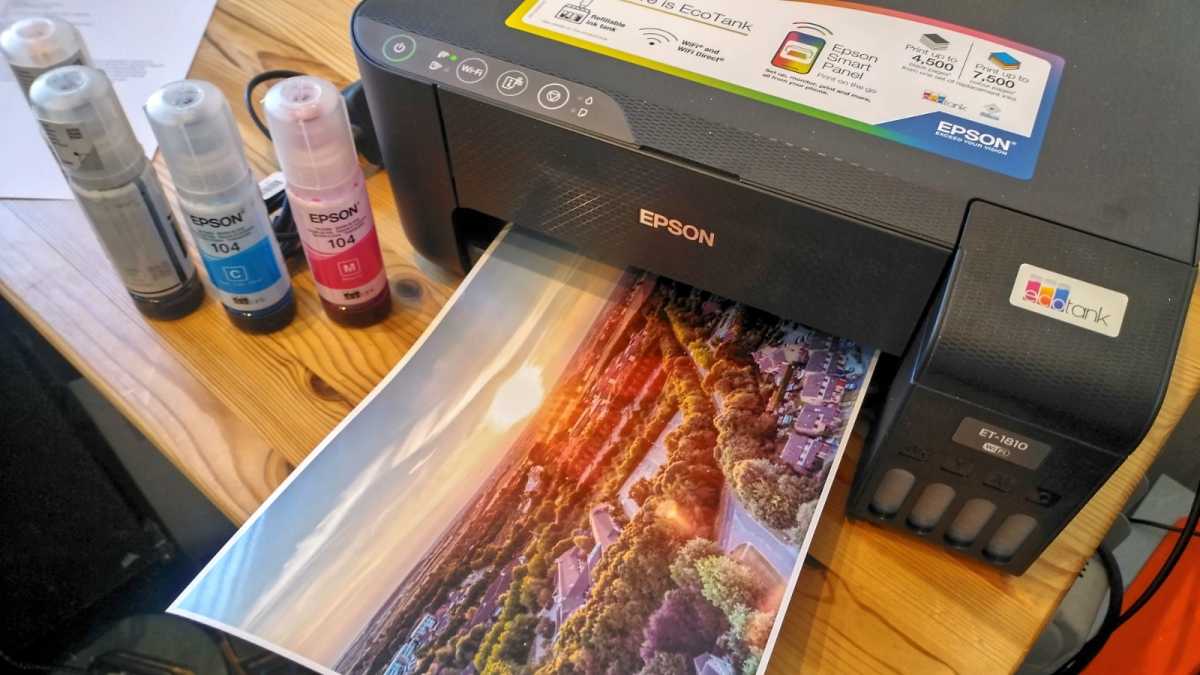
Epson has been making printers for a long time, and therefore I expected the quality of the output to be high, and it was. Using black dye instead of a pigment gives photos a more balanced look, and the print resolution is so high that individual ink pixels aren’t truly discernible.
Anyone considering the ET-1810 needs to understand that there is a caveat to photo printing on this machine. Borderless printing is limited to just 15 x 10cm prints. You can print bordered photos up to A4 or Letter, but the borderless options stop at the oddly much smaller size.
The obvious question any reviewer might ask is if that size restriction is arbitrary, or does a good reason exist?
Taking an image and printing it at full A4 page produces a print that extends within a few mm of each side with a total size of 28.8 x 20.2cm. With scissors or a guillotine, that’s the absolute limit, and the small borderless prints seem to be only a driver-determined maximum.
Once a picture is in a frame, the full-page prints have such small borders that this probably isn’t a deal-breaker and something that could, in theory, be fixed with a firmware update.
Running Costs
- Very cheap per page
- Even cheaper 3rd-party ink
- No unlimited ink options
Paying extra for an EcoTank means buyers will expect cheaper printing, and they do get that with the ET-1810. I’ve already mentioned the included ink that should be good for at least 3,600 pages of black and 6,500 of colour, at 5% coverage.
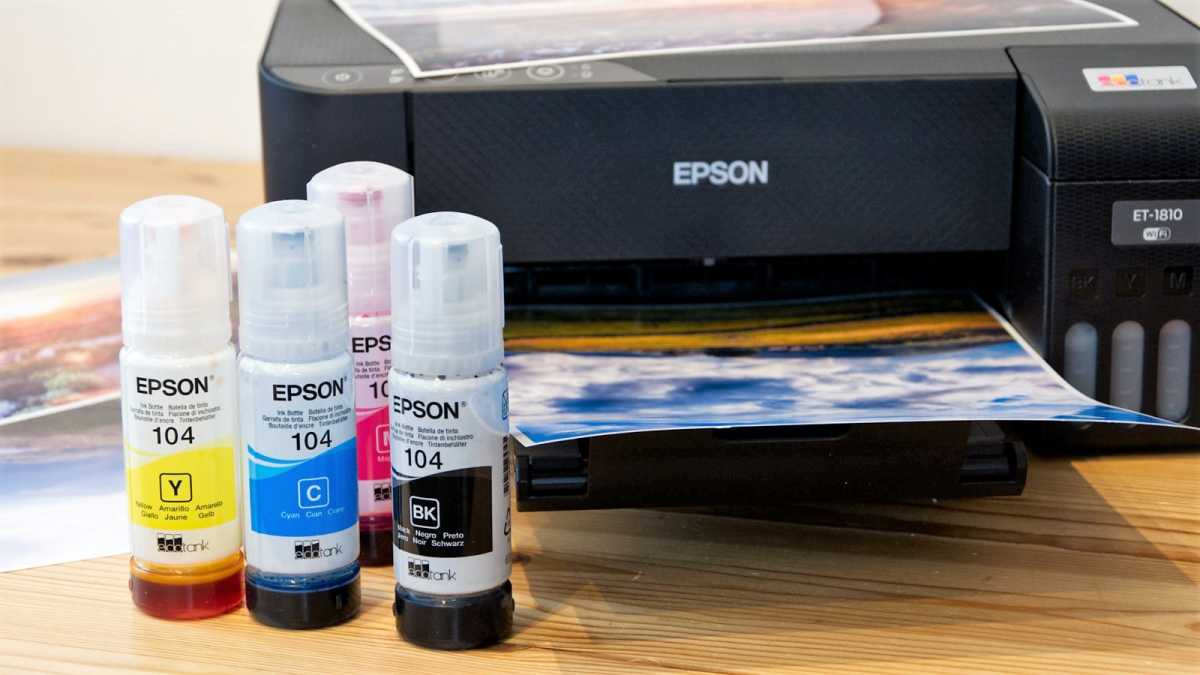
A replacement set boosts those numbers to 4,500 pages of black and 7,500 of colour, with a complete set of Epson 104 type ink costing £36.49. Individual bottles can be bought for £9.49 each should you print lots of blue, for example.
Because colour printing can also use black, the calculations for cost are a bit more complicated than they might seem. But black printing works out at around 0.21p a page at 5% coverage, and colour printing is 0.12p per page irrespective of the colour chosen.
However, it’s worth realising that while you might print text pages with 5% coverage, and minor colour elements, full colour pages will use significantly more ink.
Multiplying those numbers by twenty to get 100% gives us 4.21p for a solid A4 black page, and 2.5p for a full A4 colour page, at standard quality. But high-quality printing on more absorbent paper will also use more ink.
Compared with a cartridge printer, those are excellent numbers, though more expensive EcoTank designs still have larger tanks and ink replacement bottles, making them even cheaper.
But as ink isn’t controlled by a cartridge chip, it is possible to source alternative brand inks that should work fine in this printer, though we can’t guarantee that.
Typically, third-party ink sets cost around £16 for a four-bottle set with 6,000 pages of each dye. That reduces the per-page cost to 0.07p for colour printing. Black printing is less than a tenth of a penny per page in ink costs.
Mark Pickavance / Foundry
Those numbers invariably make paper the most significant cost component in printing, not ink.
Epson doesn’t offer its Epson ReadyPrint option of unlimited ink supply for a monthly fee on this product, and given how long the ink supply should last for most home users, this isn’t a huge problem.
What isn’t built into these prices is the wear-and-tear on the printer of use. Epson only offers a year’s warranty or 30,000 pages on this design, suggesting it might not have a big life expectancy.
Price & Availability
The ET-1810 is available in Europe but not in the USA at this time. Hopefully, that will change as this might be the perfect cheap EcoTank to use for sublimation printing, which is popular there.
Epson makes an alternative version of this design, the ET-2810, where the lid is replaced with a flatbed scanner enabling copying and scanning, all for £199.99 or less from some retailers.
It’s worth considering that both come with £36.49 of ink and not the silly starter cartridges that those types of printers are delivered. For most home users, that ink should easily see them through the first year of use, and even using official Epson ink refilling it isn’t outrageously expensive.
Canon’s equivalent design is the Canon Pixma G2520 , a printer that costs the same in the UK at £159.99. It offers very similar print speeds and ink capacity, but includes a scanner, can generate banners, and print borderless on A4. On paper, it looks better value than the ET-1810.
Currently, HP doesn’t offer an ink tank design that costs less than £200. Its cheapest design is the £209.99 HP Smart Tank Plus 559 . It has an inbuilt scanner, uses a combination of black pigments and coloured dyes, borderless printing up to letter size and has a duty cycle of just 1,000 pages.
Its print resolution is lower than either the Epson or Canon, but it does come with two bottles of black ink along with a colour set in the box. When you factor in the duty cycle and ink capacities, this printer should take a minimum of 20 months to use the ink it is delivered with.
For more options check our best printers chart .
Mark Pickavance
Verdict
The idea of a more affordable EcoTank printer is an attractive one, but it comes with a few caveats.
Those are the inability to print borderless photos above a specific size and a less than robust level of construction. The first point won’t be an issue for most owners, but Canon has the Pixma G2520 if that’s an issue.
Possibly a more significant concern is the fragile nature of this model. Plastic can be a resilient material in suitable shapes and thicknesses even without reinforcement, but in the ET-1810, its spread thinly and often lacks proper support.
When opening the printer to clear a paper jam or install inks, the top cover is held on one edge and visibly sags on the unsupported side. What might happen to the ET-1810 if something fell is a concern, as it doesn’t have enough strength to resist even modest abuse.
But irrespective of how cheaply it was made, the ET-1810 is decent where it counts. It produces high-quality output reasonably smartly. And importantly, that output has a meagre cost per page, making it ideal for those situations where lots of affordable colour printing is needed.
However, where it could truly shine is for those wishing to explore sublimation inks. An ET-1810, some sublimation inks and paper, and Cricut EasyPress 2, and you have all the equipment needed for creating elaborate sublimation colour designs on polyester t-shirts, bags, etc.
Those interested in exploring that should never put the Epson 104 inks in it before using sublimation inks, and be aware that once converted, no easy path exists to repurpose it back to conventional print operations.
For those wanting an inexpensive printer, Epson and other brands make many printers of equivalent speed and print quality designs for half the price of the ET-1810. However, this is the one where you are less likely to get paranoid about the cost of each page and when you will need to refill it.
Overall, I like the price and performance of the Epson EcoTank ET-1810, but I would like Epson to make them a bit stronger in future.
Specs
- Colour inkjet printer
- Print Method: Epson Micro Piezo print head
- Ink type: Dye tank fill
- Print resolution: 5,760 x 1,440 dpi (colour and black)
- Maximum paper size: A4 (plain), up to 20 x 25 cm
- ADF: No
- Dimensions: 375 x 347 x 169 mm (W x D x H)
- Weight: 2.9kg
Best Prices Today: Epson EcoTank ET-1810
Author: Mark Pickavance, Contributor, Tech Advisor

Mark is an expert on displays, reviewing monitors and TVs. He also covers storage including SSDs, NAS drives and portable hard drives. He started writing in 1986 and had contributed to MicroMart, PC Format, 3D World among others.
Recent stories by Mark Pickavance:
- HP Smart Tank 5105 All-in-One Printer review
Printers might not be as exciting as a new smartphone but it’s likely we all need one at some point in our lives, even if it’s just occasionally. Whether you’re working from home or need an office printer for many people to use, we have reviewed and ranked ten of the best you can buy from tank system inkjets to large laser printers.
You might want to print a calendar, gig tickets, a boarding pass or some photos you’ve taken on your phone. Many printers are multi-function and therefore also handy for scanning and copying, too.
Whatever your needs, buying a new printer can be a confusing process. Not only do you have to worry about the upfront cost and whether it can print a good photo, but you’ve also got to consider print speeds, ongoing costs and a host of potential features.
It’s worth bearing in mind that the printer market moves slowly, and the latest printers aren’t always the best. Printer tech moves slowly so reviews might not be from this year or even the year before that but they stay on sale for a long time unlike phones or laptops .
Read on below our chart for more in-depth printer buying advice on things like whether to choose inkjet or laser.
Best printers 2023
1. Canon Pixma TS7450/1 – Best Overall

Pros
- Prints quickly
- Excellent quality
- Inexpensive to buy and run
Cons
- Mobile apps aren’t always intuitive
- Bulky design
- Photos need glossy paper

Printers are hard to even find in stock right now so a great value all-rounder from Canon at under £100 is worth snapping up, even though it is quite heavy.
This is a great value all-in-one printer that’s easy to set up and use. It’s also no slough with lots of features and versatile printing including documents and photos. Cheaper printers can be expensive to run but the TS7450 doesn’t even fall into this category.
The mobile apps are a little frustrating at times but print quality is good, although you’ll want to stick to proper glossy paper for photos. Note that the TS7451 is the same printer, only in white.
Read our full Canon Pixma TS7450 review
2. HP Envy Inspire 7220e – Best Compact Family Printer

Pros
- Attractive price
- Fast printing speeds
- 2-sided printing
- Good text and photo quality
Cons
- No ADF
- Can’t print on A4 glossy paper

Those looking for a compact and easy-to-use printer for the whole family might have just found it.
The Envy Inspire 7220e is an excellent all-rounder for those needing to regularly print text and photos at good speeds and affordable costs. The printer looks nice, has wide support for different wireless printing services and offers high-quality results.
It doesn’t have an automatic document feeder but that’s normal, so as long as you don’t need to print on A4 glossy paper, it’s a bit of a steal.
Read our full HP Envy Inspire 7220e review
3. Canon Pixma TS3350 MkII – Best Budget Printer

Pros
- Cheap
- High quality printing
- Connectivity
Cons
- Slow printing
- Expensive ink
If you’re looking for a cheap printer to handle day-to-day tasks then the TS3350 MkII (or TS3320 in the US) is an excellent choice.
This is not only affordable but offers great quality printing for a range of jobs, including colour images. This is even a copier and scanner too so you’re getting a lot for your money.
It’s quite slow so isn’t a workhorse and you’ll want to get XL cartridges to keep running costs down. For printing the occasional letter, boarding pass or family photo without breaking the bank it’s perfect.
Read our full Canon Pixma TS3350 MkII review
4. HP DeskJet Plus 4120 – Excellent Value Inkjet

Pros
- Very cheap
- Easy to use
- Good photo & graphics quality
Cons
- Average text quality
- Needs Instant Ink to keep running costs down
Those on a budget needing a printer for a mix of different tasks should consider the DeskJet Plus 4120 – known as the 4155 in the US.
It’s basic in style and design with things like a simple LCD display but keeps costs down, especially if you use HP’s Instant Ink subscription service.
Read our full HP DeskJet Plus 4120 review
5. Epson EcoTank ET-3850 – Best Ink Tank Printer
Pros
- Cost per page is very low
- Good print speed
- Excellent print quality
Cons
- Pigment black isn’t ideal for photos
- Lack duplex copying
- One year warranty

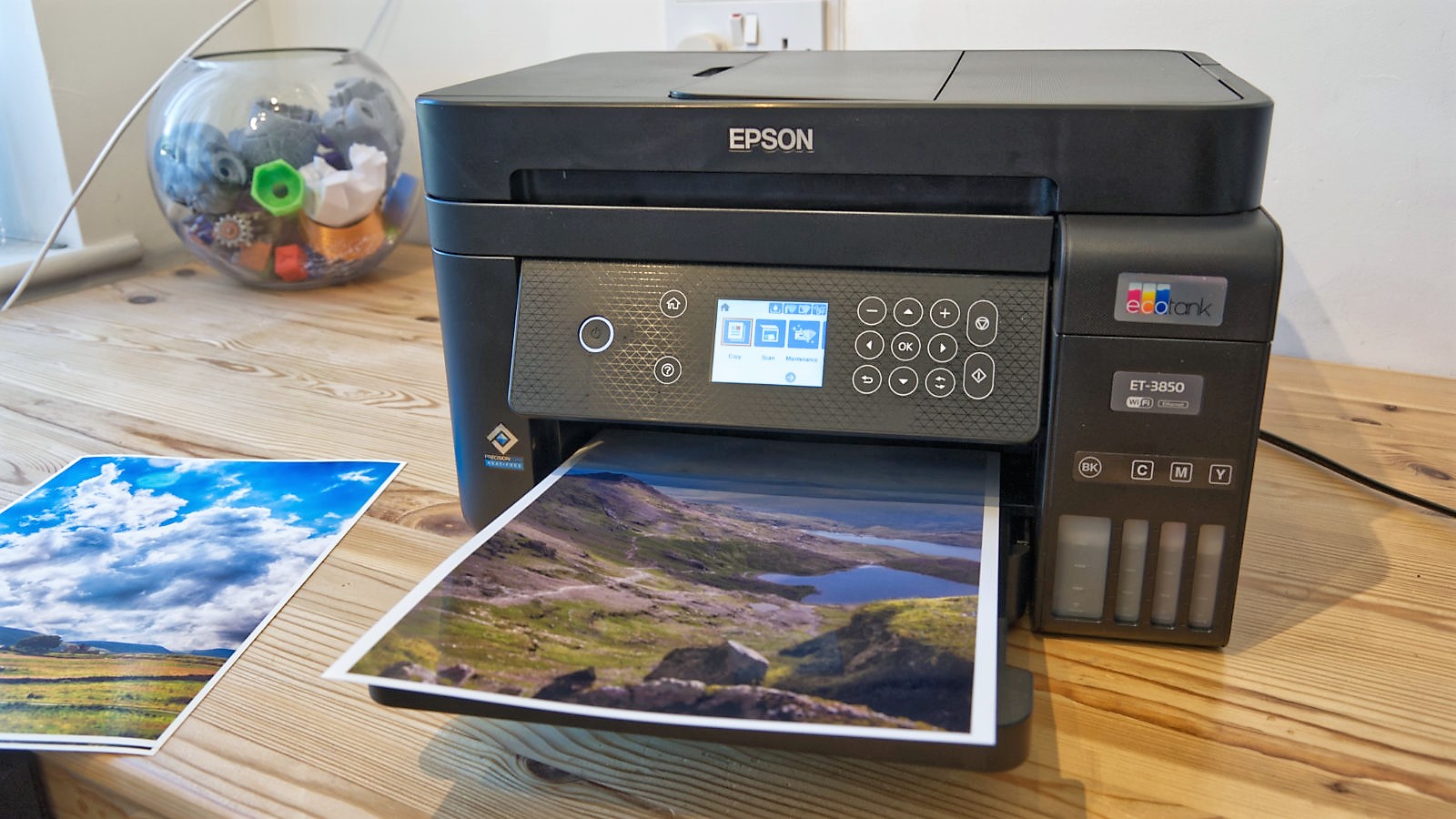
Anyone against traditional cartridges should consider this EcoTank model from Epson. The ET-3850 offers high-quality printing at decent speeds while keeping the cost down, even if you’re printing A4 colour pages on a regular basis.
It’s more expensive to buy the device itself than cartridge rivals but may well work out better value in the long run. And it has virtually the same specs as higher-end EcoTank models, including the PrecisionCore print head.
One of the main practical downsides is that it doesn’t offer duplex printing and Epson only offers a one year warranty or 50,000 pages – whichever comes first.
Read our full Epson EcoTank ET-3850 review
6. HP Smart Tank 7605 – Best Small Office Printer

Pros
- Fax function
- Dual-band WLAN
- Touch display
- Additional XL-BK ink bottle
Cons
- Limited USB host functions
- No real off switch
If you’re looking for a great all-rounder then the Smart Tank 7605 is a hot contender with its wide range of functions and large amount of ink included in the box – enough for up to 12,000 pages.
It’s highly suitable for home or small office use, even if there’s a slight overreliance on the HP Smart app. Still, it can wirelessly print, copy, scan and fax, plus has an automatic document feeder.
The compact printer looks stylish and has a 3in touchscreen, the tank system keeps costs low and print quality is good. There’s little more we could ask for at this price.
Read our full HP Smart Tank 7605 review
7. Epson EcoTank ET-18100 – Best Photo Printer
Pros
- Inexpensive photo prints
- Great print quality
- Mess-free ink refills
Cons
- No display
- No scanner / copier
- Expensive to buy
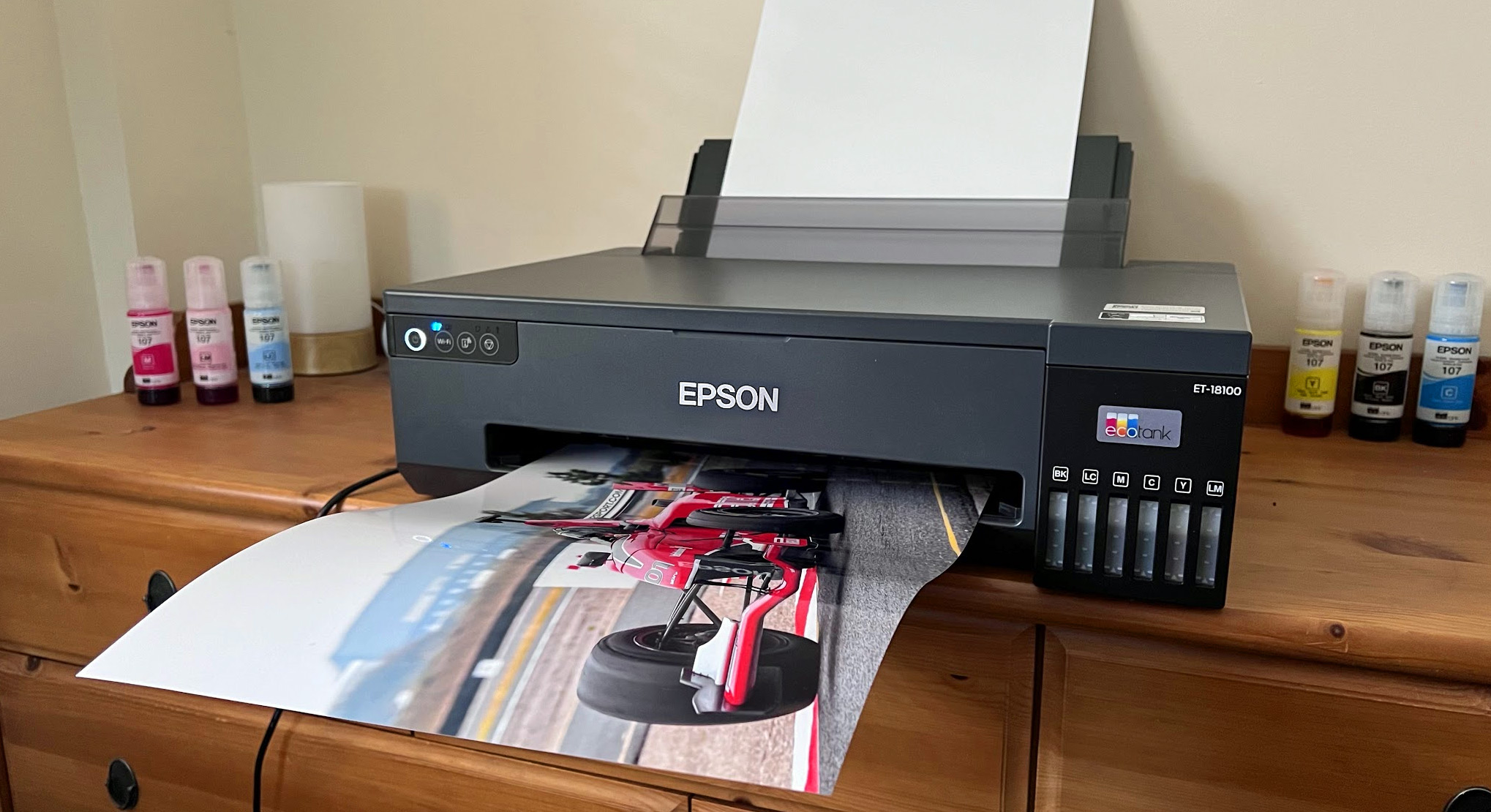
The ET-18100 has niche appeal because it’s been designed with a particular user in mind.
If you want to print a lot of photos at up to A3 sizes without breaking the bank, then you’re the target market. The printer itself is costly, but the ink tank design keeps running costs down.
The mess-free design is great and refill bottles are better for the environment, too. Print quality is excellent but as mentioned, you will need to print a lot of photos to justify this model.
With no display or copier/scanner functions, this isn’t an all-rounder.
Read our full Epson EcoTank ET-18100 review
8. HP Smart Tank 5105 – Best Value Ink Tank Printer
Pros
- Cheap running costs
- Borderless on A4, A5
- Ink tank sensors
- Affordable printer
Cons
- Flimsy
- Awkward paper path
- Only 50ml coloured inks included
- No display
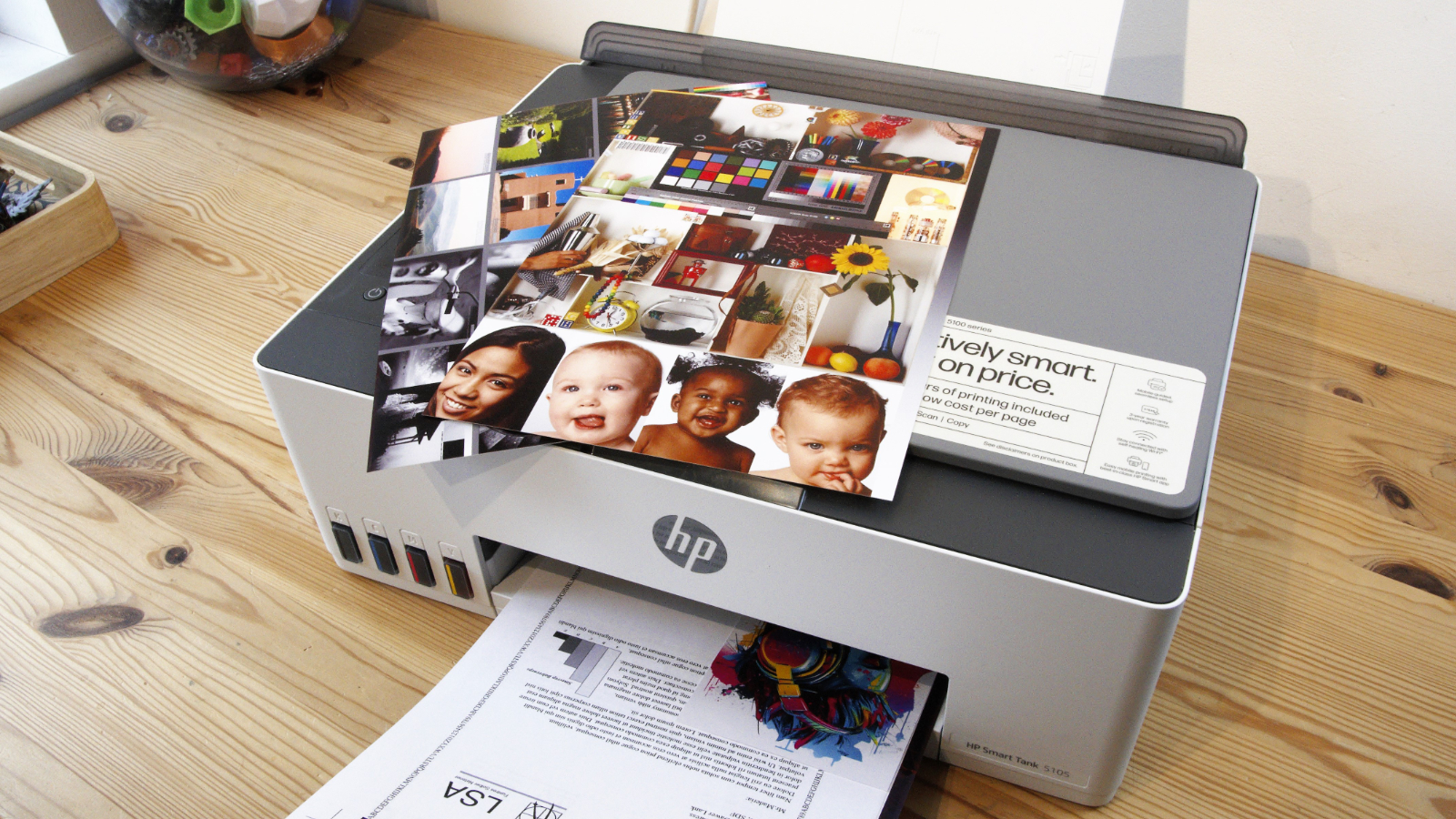
It’s great to see HP taking on Epson at ink tank printers and the 5105 is a practical solution for any home or small office customer that would like to worry less about the cost of printing.
Normally there’s a high initial price for the printer with an ink tank model but HP offers good value here, even if the supplied colour bottles are only 50ml and the build quality is on the flimsy end of the scale.
There’s also no display and this isn’t the fastest printer around either, but the quality is good for a range of tasks including surprisingly vibrant photos, and you can print borderless on A4 and A5 sheets.
It’s not all singing, all dancing but if a value for money ink tank printer is what you need then the 5105 is worth a look.
Read our full HP Smart Tank 5105 review
9. Epson Ecotank ET-8500 – Best Value Photo Printer
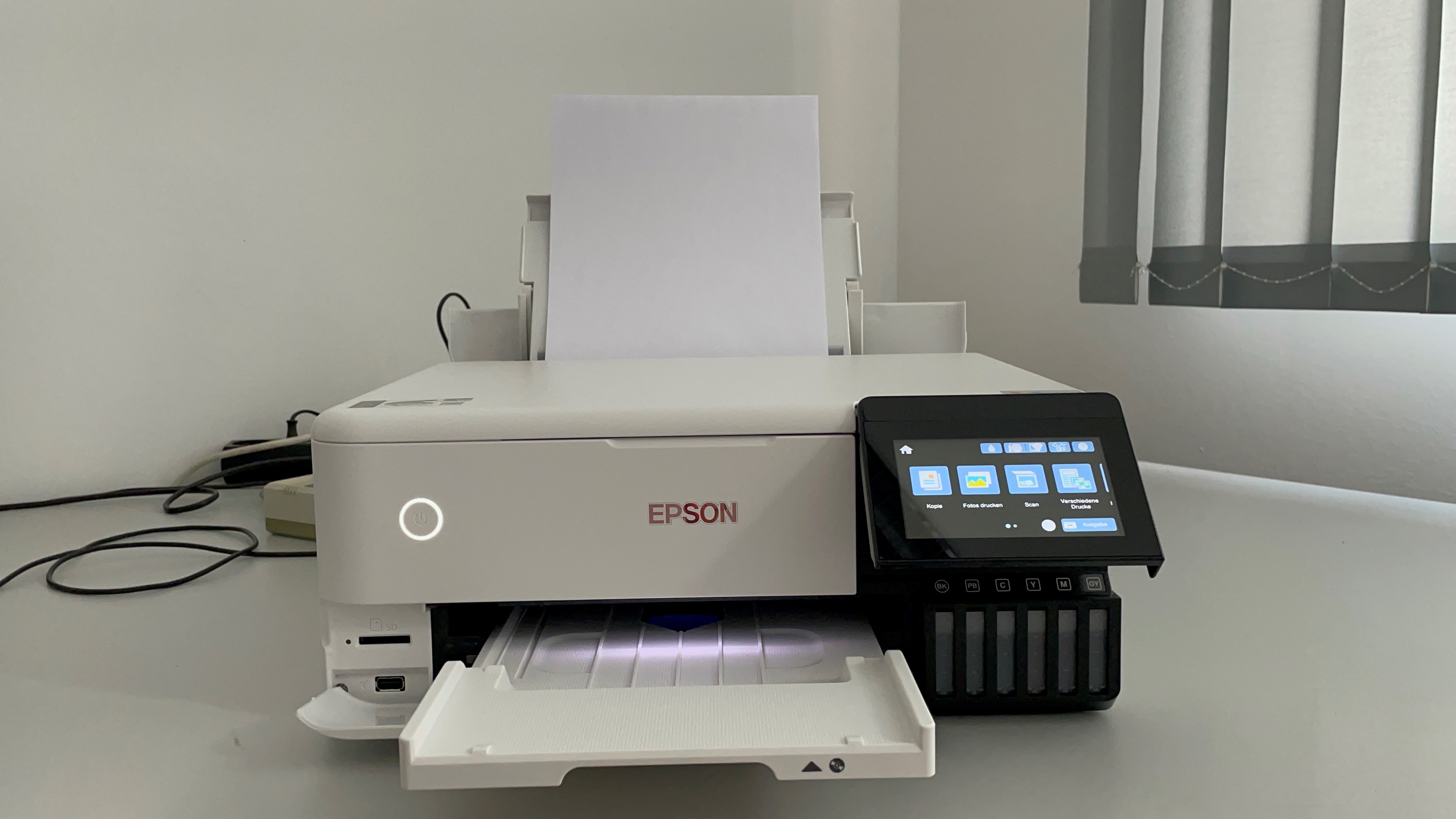
Pros
- Very high print quality
- Top for greyscale photos
- Processes many types of material
- Very low cost per page despite 6 colours
Cons
- No real off switch
- High purchase price
If printing photos is your thing, then the EcoTank 8500 is an excellent choice as this printer is designed for the task, although it can do regular printing and scanning as well.
It’s a fairly expensive printer at first but if you’re planning to print a lot of images then it should work out as a good investment in the long term with reliability and print costs.
Importantly, print quality is excellent and you can print on a variety of materials including fine art paper. It’s also got a large 10cm screen and no less than three different paper feeds.
Read our full Epson Ecotank ET-8500 review
10. Brother DCP-L3510cdw – Best Laser Printer

Pros
- 2-sided printing
- Decent performance
Cons
- Single-sheet scanning
- No colour screen
- Running costs
If you don’t need to print photos on photo paper but instead need a printer primarily for documents then a laser is a great choice.
The Brother DCP-L3510cdw uses LEDs instead of a laser, but it’s very similar and can reliably handle lots of printing with crisp quality at a decent speed.
You’ll need more room for it than a typical inkjet printer but running costs over the long term are more affordable and with Brother’s EcoPro subscription you get the printer for just £1.20!
This model has a basic LCD screen but still has useful features including 2-sided printing, a single-sheet scanner and Wi-Fi, complete with AirPrint support.
Read our full Brother DCP-L3510cdw review
How to choose a printer
There’s no single printer that will suit everyone, so while the list below is ordered it’s best not to worry too much about the number beside it. We’ve mixed together home and business printers, multifunction, colour and mono.
Inkjet vs laser
Printers come in two main forms: inkjet or laser, with colour and mono flavours of each. Lasers tend to be more expensive to buy, but provide better quality output, particularly where lots of text is involved. And they can be faster. Notice we said ‘tend’ – lasers aren’t always best.
As a basic rule, if you need to print only text, and a lot of it, a mono laser printer will offer the crispest text output and the best combination of fast page-per-minute output and low ink costs. If you need to print photos, choose an inkjet printer. A dedicated photo printer with individual cartridges for each colour will suit those who print only photos.
If you’re working from home and need to print a lot, a laser printer is likely going to be a better option.
You can also read our more in-depth comparison of the pros and cons of each type of printer .
What are printer running costs?
When buying a printer, remember that the price you pay in the store is just the beginning. Be sure to consider the cost of replenishing toner and other consumables over the lifetime of the printer. This is particularly important if you print a lot. A set of toner cartridges can easily approach the cost of a colour laser printer.
Most manufacturers quote a ‘page yield’ estimate for their ink cartridges, which is the typical number of pages you can expect to print before the cartridge runs out of ink. You can use the page yield to calculate the average cost per page and you’d be surprised to find how much this can vary from one printer to another.
Of course, if output quality matters more to you than cost, scoot over to the other end of the cost spectrum where there are more specialised printers that use five or even six inks for printing photographs. Those additional inks can produce excellent results for your photo prints, but they add to the cost, sometimes pushing the cost for photos up to 10p or more per page.
Some brands offer a cartridge subscription service, like HP’s Instant Ink , to keep costs to a minimum.
What is a multifunction printer?
Most modern printers are multifunction ‘all-in-one’ devices that include a scanner too. This allows you to scan photos and other documents and convert them into digital files that you can store on your computer or share with friends or colleagues. You can also print copies of your scanned documents, allowing the printer to stand in for a photocopier too.
Some models even include a fax machine. If you require a scanner and a photocopier as well as a printer, you’ll save money by buying in all-in-one – but if a standalone printer suits your needs, you may be able to spend less.
What about print speed and features?
Speeds quoted by manufacturers are almost never matched by real-world performance. If you often need to print in a hurry, look for independent reviews when choosing your printer.
Other useful features to look out for include additional USB ports and memory card slots that will allow you to print photos direct from a camera.
High-capacity paper trays capable of holding hundreds of sheets of paper, or an automatic document feeder that can handle scanning and copying work while you go and do something more important, might be worth looking out for.
Double-sided printing is handy for halving your paper usage.
It’s also worth thinking about the bundled software that comes with your printer. Some printers include software that provides basic editing features, such as red-eye removal or adjusting the colour balance – some even allow you to perform simple editing tasks using controls on the printer itself.
Author: Chris Martin, Managing Editor, Tech Advisor

Tech Advisor Managing Editor Chris got his break as a reporter at infamous site The Inquirer and has been with us for more than 12 years. With a BA degree in Music Technology, audio is his specialism, but over the years he has reviewed all kinds of gadgets, from smartwatches to mesh Wi-Fi to coffee machines.
Recent stories by Chris Martin:
- Canon Pixma G4510 review
