The Google Pixel 8 and Pixel 8 Pro are the latest additions to the Pixel family. These two smartphones offer plenty of great features, but unless you’re going to buy both you’ll need to decide betweeen the regular model and the Pro.
To help in that quest, we compare the Google Pixel 8 and Pixel 8 Pro so you understand how they differ and which is the right choice for you.
A new generation of Pixel phone is coming. Check out our coverage of the Google Pixel 9 and Google Pixel 9 Pro Fold , which we expect to arrive in August 2024 running all-new Android 15 , potentially alongside a new Pixel Watch 3. (Do keep your eyes peeled for deals on other Pixel devices in the meantime!).
Differences between Google Pixel 8 and Pixel 8 Pro
Looking at both smartphones, it’s hard not to mistake them for Pixel 7 and Pixel 7 Pro, as Google has stuck to an established design this time around. Of course, there are differences, and even more so between the Pixel 8 and the Pixel 8 Pro.
The Pixel 8 is compact and lightweight (187g), making it comfortable for one-handed use. It’s available in Hazel, Rose, and Obsidian.
On the other hand, the Pixel 8 Pro is slightly larger and heavier (213g), which is still manageable but feels more substantial. It’s available in these three colours: Bay, Porcelain, and Obsidian.
The choice between the two regarding size and weight depends mostly on your preference for a more compact phone (the Pixel 8) or a larger device with a bigger screen (the Pixel 8 Pro).
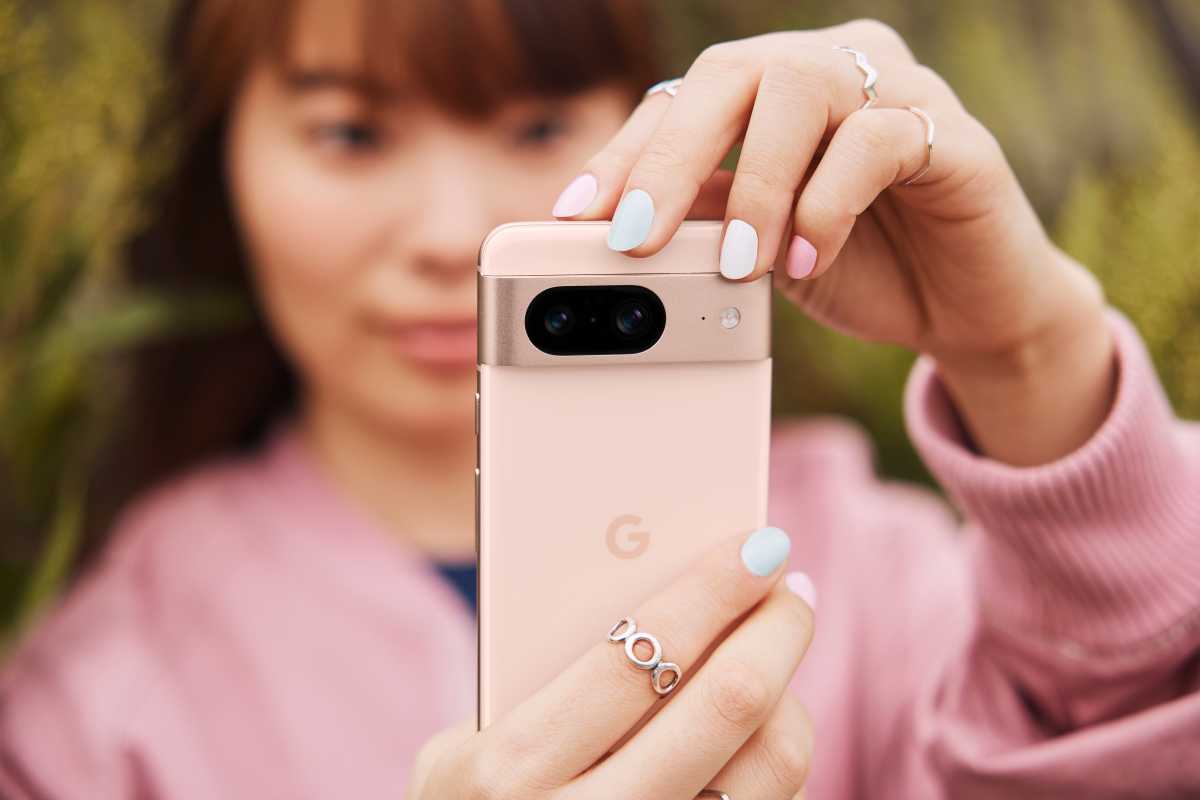
Pixel 8
The Google Pixel 8 boasts a 6.2in OLED display that supports a variable refresh rate of 60–120 Hz for smooth scrolling and responsiveness, and is protected by Corning Gorilla Glass Victus. It also supports HDR content with up to 1400 nits of peak brightness.
In contrast, the Google Pixel 8 Pro has a larger 6.7in LTPO OLED display with a slightly higher resolution. The Pixel 8 Pro’s display, because it’s LTPO, offers an even wider variable refresh rate range of 1–120 Hz. It get Corning Gorilla Glass Victus 2, which is tougher, and goes up to an impressive 2400 nits of peak brightness, making it a better choice for a outdoor usage in full sun, and better-looking HDR video.
In terms of display quality, both phones offer vibrant colours and high contrast ratios, but the Pixel 8 Pro’s larger and more versatile LTPO OLED display has the edge.

Pixel 8in Obsidian
Both the Pixel 8 and Pixel 8 Pro are designed to last throughout the day and beyond, but we’ve not yet had a chance to use these phones in the real world to know exactly how long each one goes between charges.
The Pixel 8 supports fast charging and Google says it will reach up to 50% battery in approximately 30 minutes with the official 30W USB-C Charger. Additionally, it supports Qi-certified wireless charging and Battery Share, a feature that lets you charge other devices.
The Pixel 8 Pro, on the other hand, packs a larger battery with around 500mAh of extra capacity. Whether that translates into longer battery life remains to be seen, because the bigger, brighter display could well use it up.
Like the Pixel 8, the 8 Pro also supports fast charging, wireless charging, and Battery Share.

Pixel 8 Pro
Both phones come with Android 14 and are equipped with the Google Tensor G3 processor and Titan M2 security coprocessor. Again, we’ve yet to run our benchmarks to see exactly how they compare to rivals – and the Pixel 7 and Pixel 7 Pro – but it’s sure to be a step forward, as it is every year.
Given the differences in performance that last year’s models had between them, it is reasonable to assume that the Pixel 8 Pro will have better performance than the Pixel 8.
The Google Pixel 8 is available with 8GB RAM and 128GB or 256GB storage. Meanwhile, the Pixel 8 Pro comes with 12GB RAM and offers more extensive storage options, ranging from 128GB to a whopping 1TB storage.
This makes the Pixel 8 Pro the clear choice for anyone that needs a lot of storage and runs demanding apps on their phone. But you can always use Google’s cloud storage (or some other provider) and opt for the base model.

Pixel 8phone call
Both the Pixel 8 and Pixel 8 Pro have impressive camera systems, just as you’d expect from Google phones. The Pixel 8 has a 50-megapixel main camera and a 12-megapixel ultrawide camera. Its front camera is a 10.5-megapixel selfie camera.
If you go for the Pixel 8 Pro, you get the same 50-megapixel main camera, a 48-megapixel ultrawide camera, and a 48-megapixel 5x telephoto camera. Its front camera is the same 10.5-megapixel selfie camera as in the Pixel 8.
The Pixel 8 Pro is clearly more versatile for avid photographers.
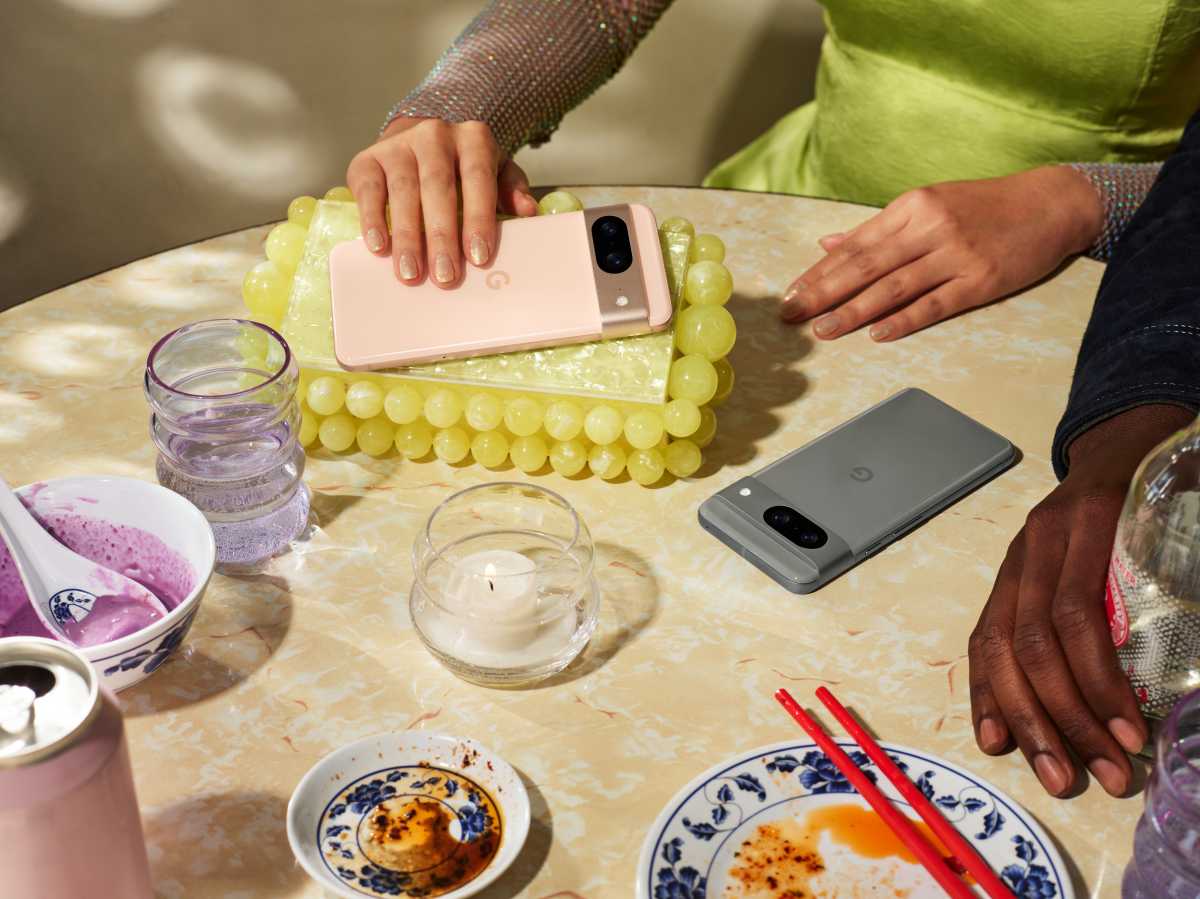
We have no idea what’s happening in this photo
Price & availability
The Pixel 8 starts at $699 / £699, and you can purchase it directly from Google .
The Pixel 8 Pro starts at $999 / £999 and is also available for purchase directly from the Google store .
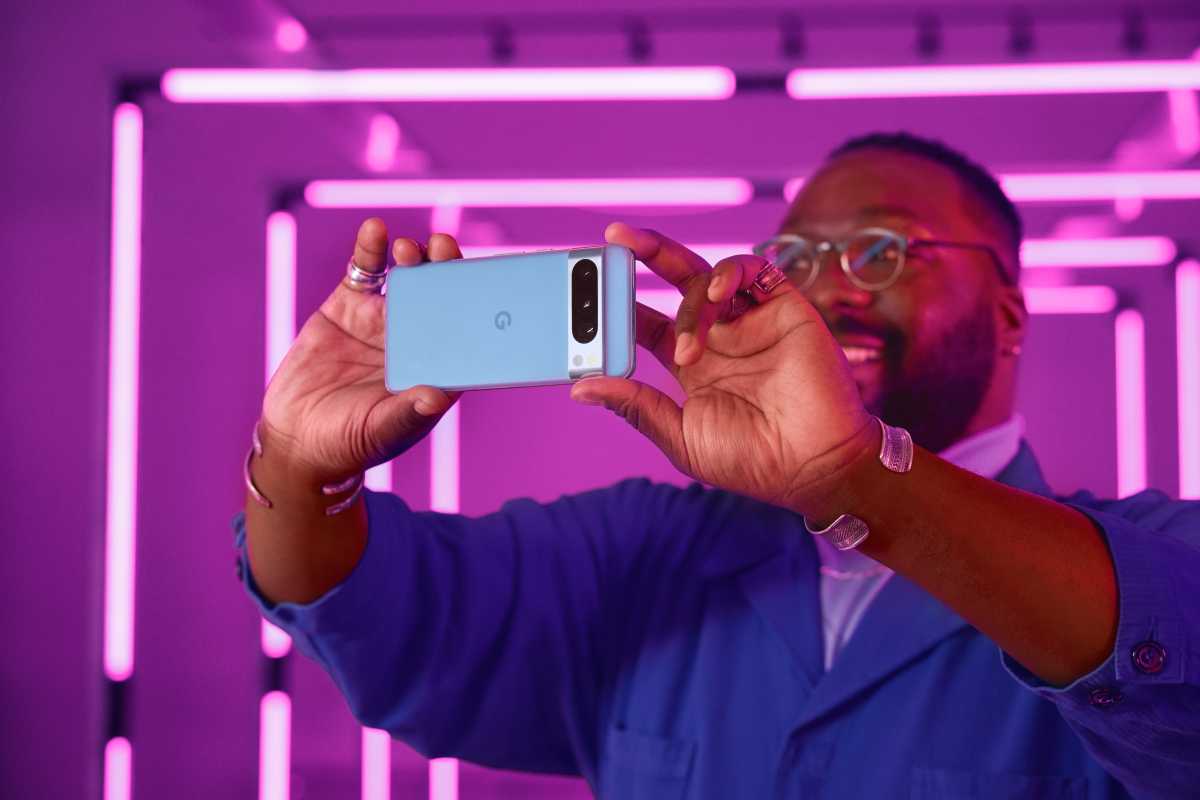
Pixel 8 Pro
Verdict
If your question is simply “which is the better phone?” then clearly the Pixel 8 Pro is the answer. However, you didn’t need us to tell you that. Ultimately, whether the Google Pixel 8 or Pixel 8 Pro is the best choice for you will depend on your priorities and preferences, as well as your budget.
If you prefer a more compact, lightweight phone that also offers flagship performance, display, and camera quality, the Pixel 8 is an excellent choice.
On the other hand, if you crave a larger, more powerful device with enhanced camera capabilities and ample memory and storage, the Pixel 8 Pro is the way to go. Both phones are excellent options, offering top-tier features and the signature Google experience. The decision comes down to what suits your needs and fits your budget.
Specs
Google Pixel 8:
- Full-screen 6.2in Actua display, 20:9 aspect ratio, (1080 x 2400) OLED at 428 PPI, 60–120 Hz
- Corning Gorilla Glass Victus cover glass
- Always-on display with At a Glance and Now Playing
- Up to 1400 nits (HDR) and up to 2000 nits (peak brightness)
1,000,000:1 contrast ratio
- HDR support
- Full 24-bit depth for 16 million colors
- Google Tensor G3 with Titan M2 security coprocessor
- 8GB LPDDR5X RAM or 128GB / 256GB UFS 3.1 storage
- Beyond 24-hour battery life
- Up to 72-hour battery life with Extreme Battery Saver
- Minimum 4485 mAh, typical 4575 mAh
- Fast charging up to 50% charge in about 30 minutes
- Qi-certified
- Fast wireless charging
- Battery Share
- Cameras: 50 MP Octa PD wide camera 12 MP ultrawide camera with autofocus 10.5 MP Dual PD selfie camera
- 5.9 height x 2.8 width x 0.4 depth (inches) / 149.8 x 71 x 10.1mm
- 187 g
- Colours: Hazel, Rose, and Obsidian
Google Pixel 8 Pro:
- Full-screen 6.7in Super Actua display, 20:9 aspect ratio, (1344 x 2992) LTPO OLED at 489 PPI, 1–120 Hz
- Corning Gorilla Glass Victus 2 cover glass
- Always-on display with At a Glance and Now Playing
- Up to 1600 nits (HDR) and up to 2400 nits (peak brightness)
1,000,000:1 contrast ratio
- HDR support
- Full 24-bit depth for 16 million colors
- Google Tensor G3 with Titan M2 security coprocessor
- 12GB LPDDR5X RAM or 128GB / 256GB / 512GB / 1TB UFS 3.1 storage
- Beyond 24-hour battery life
- Up to 72-hour battery life with Extreme Battery Saver
- Minimum 4950 mAh, typical 5050 mAh
- Fast charging up to 50% charge in about 30 minutes
- Qi-certified
- Fast wireless charging
- Battery Share
- Cameras: 50 MP Octa PD wide camera 48 MP Quad PD ultrawide camera with autofocus 48 MP Quad PD 5x telephoto camera 10.5 MP Dual PD selfie camera
- 6.4 height x 3.0 width x 0.3 depth (inches) / 162.5 x 76.2 x 7.6mm
- 213 g
- Colours: Bay, Porcelain, and Obsidian
Author: Artur Tomala, Mobile Writer, Tech Advisor

Artur is a Mobile Writer at Tech Advisor, where he covers a range of smartphone, tablet and smartwatch-related topics. He has been working in the tech industry since 2021, including time spent leading a team focused on mobile news, reviews and product rankings. As an ambassador for the productivity app Notion, he runs training workshops and creates advanced templates to help people stay organised and productive.
Recent stories by Artur Tomala:
- How to set up a new Android phone
- Samsung Galaxy A26: Everything you need to know
- What is an eSIM and how does it work?
