Dyson’s WashG1 is now available to buy in both the US and the UK . As the name suggests, it’s a wet floor cleaner. It’s the first dedicated cleaner of its type that Dyson has produced – although there is a wet cleaning head on the V15s Submarine.
You can read our WashG1 review and our V15s Submarine review to to decide which model is better for you.
For the first time in its floor care range, Dyson has moved away from cyclone technology. Or, as the UK Dyson press office would have it (cruelly pre-empting similar puns from journalists), the WashG1 is “a wet floor cleaner that doesn’t suck”.
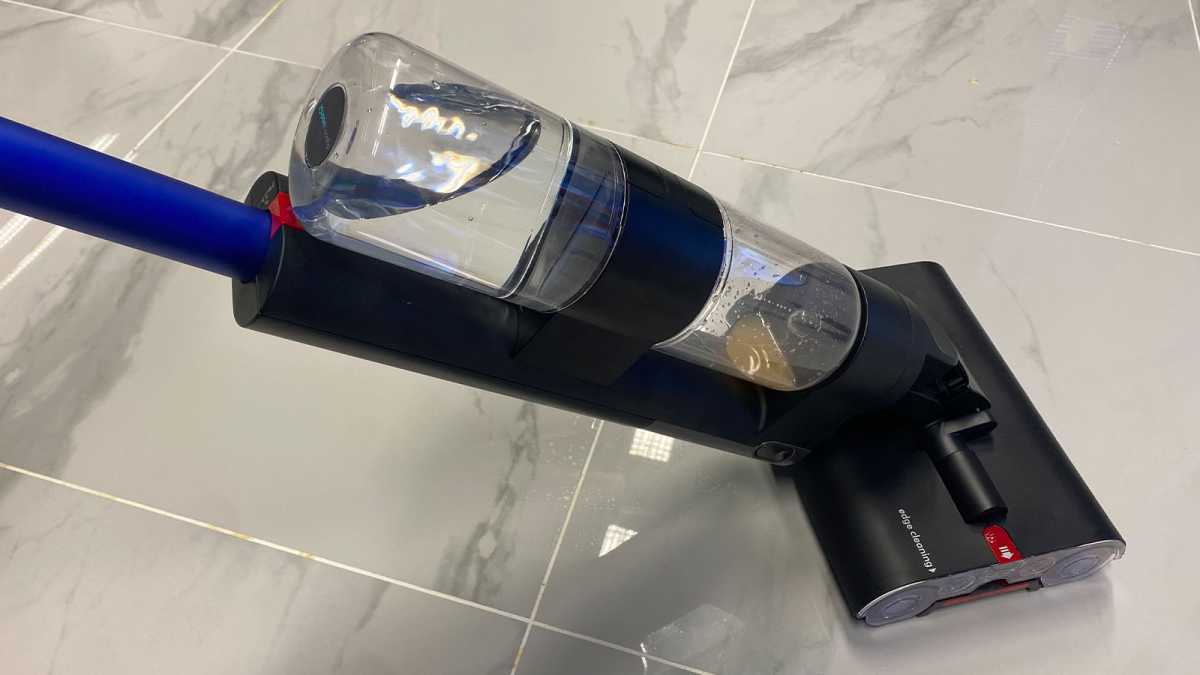
The 4.5kg WashG1 has a simple, minimalist design. Its colour scheme is a little more muted than other Dyson cleaners, with a black floor head, handle and accessories, and a simple, angled, metallic blue wand. Mounted on the front are 1-litre clean and dirty water tanks.
Emma Rowley / Foundry
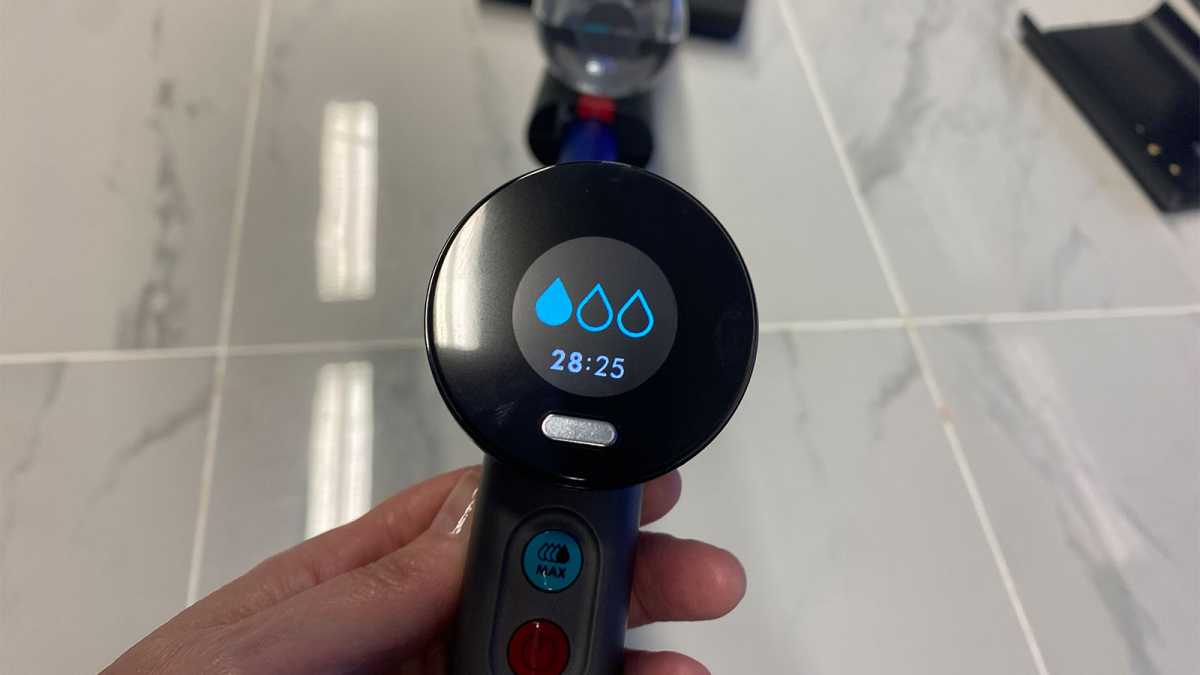
The controls and display are equally pared back, with an LCD screen that shows water level and remaining time, and just three buttons. One is for power, one cycles between low, medium and high water usage – plus there’s a boost button if you really need to give the floor a good soaking.
I was one of the lucky few allowed to try it out at Dyson’s Malmesbury campus before it was officially announced. We’ll give it a full review as soon as we’re able to test it properly – but from a short trial, I can say that there’s a lot to like about it.
It feels light and manoeuvrable, its display is clear, and it’s intuitive and easy to use. When it comes to emptying and refilling, the clean and dirty water tanks pop off together, which makes it much less of a faff to do.
But there’s one design element that I do not like one bit…
Dyson is very keen to display the effectiveness of its cleaners. All of its vacuums have clear dustbins, and its most recent models (including the V15 Detect and the Gen5detect ) feature a piezo sensor and LCD screen that work together to show you the volume and type of dust and dirt particles you’ve vacuumed up. The message is as clear as the bins: these vacuums may be pricey but they’re effective.
The WashG1 is no different. Unlike many other wet floor cleaners, which have smoked, frosted or coloured dirty water tanks to obscure the unpleasantness within, the WashG1 has a perfectly transparent, highly visible tank – because Dyson wants you to see all the muck you’re removed from your hard floors.
And view it you will, because thanks to the sparse, elegant design of the WashG1, it’s right in front and impossible to ignore. Personally, I found it a little bit gut-churning as it fills up.

Emma Rowley / Foundry
It’s understandable that Dyson wants you to see how much better the WashG1 is than your regular ol’ mop. But if you’ve spilt half a can of soup on the floor, it’ll be fairly obvious when it’s gone, so do you really need to look at a tank full of watery orange mess?
How the WashG1 works
Charlie Park, VP of Dyson Home Engineering says: “Dyson engineers solve the problems others ignore and we thrive on the challenge of creating better technology. The Dyson WashG1 is the result of this; our first dedicated wet machine to wash hard floors, properly and hygienically.”
Dyson’s approach was characteristic. The floor care industry has three standardised tests for wet floor cleaners: dried-on blobs of tartar sauce, mustard and coffee. Dyson felt this wasn’t sufficient for the breadth of problems a cleaner would need to tackle, so it developed its own tests for more types of likely spills. These included wet spills, makeup, hand sanitiser and more, with the idea that it’s not just what’s in the pantry but what’s in the bathroom that’ll need to be cleaned up.
What it came up with is a complete wet floor cleaning system for all hard flooring types that can deal with both wet and dry debris. What’s more, it separates wet from dry, so you won’t have to deal with the unpleasantness of pulling a handful of hair from the dirty water tank before emptying. (I’ve been there.)
It doesn’t use suction in the traditional sense, in that it doesn’t suck water up from the floor, like most rival wet floor cleaners. Instead, it disperses water via 26 points along the cleaning head and employs two counter-rotating microfibre-coated rollers to pick up dirty water and debris. An advantage of the twin rollers is that the WashG1 cleans as it moves forward and back, unlike single-roller rivals.
However, it does use suction in the form of a small pump that sucks air out of the water tank. As the pump never comes into contact with water, thanks to a spigot which closes the air valve, there’s no need for a filter to protect the motor from liquid. This allowed Dyson to banish the replaceable filter you’ll find in most rival wet vacuums, which picks up odour and bacteria.
Emma Rowley / Foundry
The clean water tank and battery life will give you up to 290m 2 of cleaning, or about 45 minutes of cleaning time. The limiting factor in the WashG1 isn’t battery life – it’s water use. So, if you use the highest water level, you’ll only get 7-8 minutes of cleaning time before the water depletes and the dirty tank is close to filling up.
Like any wet floor cleaner, you’ll get the best results by running an ordinary vacuum around first as there’s less chance of clogging up the system. However, Dyson reassured me that shorter hair, such as pet hair, won’t be a problem thanks to the secondary brush bar. Microfibre on the cleaning rollers will grip pet hair until it comes into contact with the bristle bar, which is designed to flick hair and debris into the debris tray, which can be emptied separately.
The WashG1 stands in a charging dock and, after use, you can start the self-cleaning mode, which is another thing you won’t have to worry about. There’s no hot air drying for the rollers, however, and long hair may have to be removed from the bristle bars by hand.
Dyson WashG1 price & availability
The WashG1 is available to buy from Dyson in the UK priced at £599.99 and from Dyson US for $699.99. For more recommendations, have a look at our round-up of the best wet and dry vacuums to find the best model for you.
Author: Emma Rowley, Deputy Editor, Tech Advisor

Tech Advisor’s Deputy Editor, Emma has been a journalist and copywriter for over 20 years and has been testing and writing about home tech and appliances for seven years. She tries out every appliance she writes about at home, and aims to recommend time- and energy-saving products that will last.
Recent stories by Emma Rowley:
- The vacuum cleaner I tell everyone to buy is over half off for Black Friday
- The best Dyson cordless vacuums – tried and tested
- Dyson V16 Piston Animal review: Anti-hair wrap tech that actually works
