At a glance
Expert’s Rating
Our Verdict
No Other Choice might not be Park Chan-Wook’s best film, but it’s a masterpiece nonetheless. This madcap anti-Capitalist fable is sure to outlast the vast majority of other films that the Oscars nominated this week instead.
Best Pricing Today
There is a precision to everything director Park Chan-Wook does, be it the flawless mirror scene in Decision To Leave or the perfect choreography in Oldboy’s oft-cited hallway brawl. Over a career that spans a quarter of a century, the South Korean auteur’s perspective is as sharp as a paper cut. But life isn’t so precise and neither are the stories that he tells.
Park’s latest film, No Other Choice, is the perfect example of that, even if you wouldn’t necessarily know it at first.
Lee Byung-hun’s family man, Yoo Man-su, seems to live a perfect life, as crisp and pristine as the luxury paper he helps make as a veteran at the Solar Paper company. Of course, it doesn’t last long. A few scenes in, Man-su is suddenly made redundant, left adrift in a ruthless job market where choice is no longer viable.
This being a Park Chan-Wook film, you might assume that vengeance is right around the corner – and it is, but not in the way you might expect. Instead of taking his frustrations out on the executives responsible, Man-su plays the system, setting up his own fake company to lure in rival job applicants (Park Hee-soon, Lee Sung-min) so he can kill them and secure a position of his own.
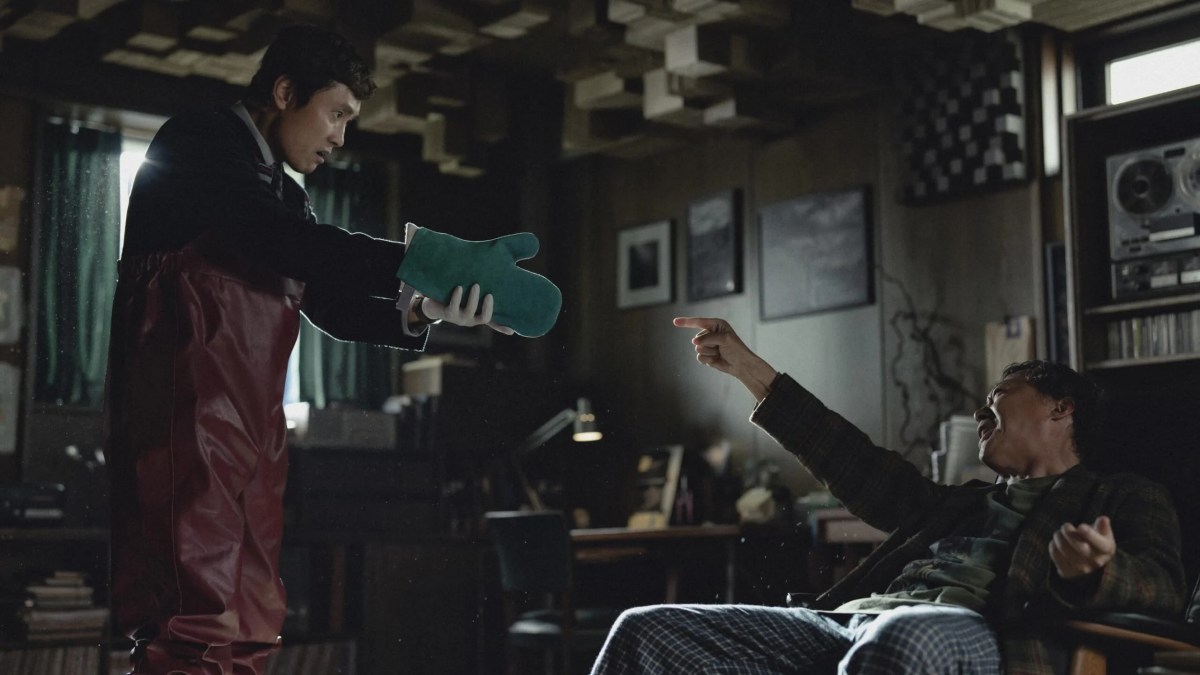
What ensues is refined chaos, a mix of tension, pathos and slapstick all at once. Absurd Looney Tunes-style moments come thick and fast in the first half, culminating in a home invasion where Man-su, an old rival (Lee Sung Min), and his theatrical wife (Yeom Hye Ran) out-scream each other to deafening music, grappling with a gun and oven gloves alike.
The lunacy of what unfolds is grounded in a desperate believability with undercurrents of the macabre that come into greater focus later on. Bright, expressive lighting gradually gives way to a muted palette as we watch a man choked to death by his own vomit or another trussed up like a dead pig.
Cinematographer Kim Woo-hyung eyes all this in the most inventive way possible, peering up from the bottom of a shot glass or even from the viewpoint of a corpse laid out on the ground.
It’s exhilarating to see cinematic masters working at the top of their game like this, pushing the boundaries of form with such dizzying glee. And crucially, there’s always intention, a sense that every split second has been considered, down to the smallest detail. Even as No Other Choice shifts between genres, Park always has a tight handle on the story at play, toying with murky morals in a world where fighting for what’s yours feels alarmingly relatable.
That signature precision is evident in every aspect of No Other Choice, including the cast’s performances across the board. Watching Lee Byung-hun quiver with rage one minute and then shimmy over to his wife on the dance floor, you’re struck by how mercurial he is. Bumbling yet sympathetic, chilling yet relatable, this role is a culmination of sorts for a true industry legend, showing off every facet of the talent he’s honed across four decades on screen.
NEON
Son Ye-jin, meanwhile, finds humanity in family disarray, grounding the bedlam as matriarch Lee Mi-ri. Then, on the opposite end of the spectrum, Yeom Hye-ran continues her generation-defining run of roles as the somewhat unhinged Lee A-ra, wife to one of Man-su’s victims.
How the Academy could overlook her, or any of these performances this year, is a crime far greater than anything Man-su gets up to.
But the biggest crime of all would be to skip No Other Choice in the cinema.
It’s there in a dark room that you’ll laugh hardest at the absurd lengths Man-su will go. It’s there in a dark room that you’ll gaze awestruck at Park’s signature transitions, each holding the power to remind you of cinema’s true potential. And it’s there in that dark room that you’ll come to appreciate the smaller details that thread the madness into wider universal themes of discontent.
No Other Choice is based on a book titled The Ax that American author Donald E Westlake wrote all the way back in 1997, but Park’s reimagining (with help from co-scriptwriters Lee Kyoung-mi, Don McKellar, Lee Ja-hye) couldn’t be more timely. Because when else would we root so strongly for a man who’s out to kill just to get a job that he doesn’t want but sorely needs? This anti-capitalist fable cuts to the quick, as precise as a paper cut and far more deadly.
Should you watch No Other Choice?
As bleakly funny as it is thrilling, No Other Choice amuses and horrifies in equal measure. This is top-tier filmmaking, the kind of generational masterpiece that could only come from one of our greatest living filmmakers. Just don’t compare it to Parasite because that does a disservice to both.
No Other Choice is out in cinemas in the UK from 23 January.
Author: David Opie, Contributor, Tech Advisor

David Opie is an entertainment journalist who writes about gay and geeky stuff across a range of publications including IndieWire, Empire, Radio Times and more. Specialties include horror, superheroes, and LGBTQ+ storytelling, which is why he longs to see a Buffy-themed Rusical on RuPaul’s Drag Race. Find him at @DavidOpie on X.
Recent stories by David Opie:
- His & Hers season 1 review: Tessa Thompson and Jon Bernthal bring the heat in dangerous Netflix thriller
- Can’t watch Heated Rivalry? This spicy new Netflix film is for you
- IT: Welcome To Derry finale confirms tragic fan theory – with a twist
