At a Glance
Expert’s Rating
Our Verdict
The TP-Link AV1000 series of Powerline adapters has been updated, and is a well-made and fast set of data shifters at great prices. In some speed tests we actually found it faster than the supposedly more able TP-Link AV1200 adapters, so it punches above its weight. We help you pick the right model for your home networking needs.
Best Prices Today: TP-Link AV1000 Powerline

If your home Wi-Fi isn’t up to fast file transfers or TV streaming your favourite TV shows to your smart TV, or you need speedier gaming for your console in your bedroom then Powerline might be your saviour.
Powerline is a simple technology that uses the power cables in your home to act like networking cables—so taking much less time to shuttle data around your building.
It’s super easy to set up. You just plug one base adapter into the power socket near your modem/router, and then connect those two devices together with a supplied Ethernet cable.
Then you plug the second adapter (and third and fourth if you need them) into the socket near your TV, Sky box, Tivo, games console, laptop, desktop PC and so on. You can then connect these devices to the second adapter via another Ethernet cable.
That way you get data speeds close to what you get if you connected your TV or whatever directly into your router.
While the images here show the UK plug models, most should be available in the US and other countries. Links to the best prices are included below.
What’s in the box
To get started with Powerline you need a starter kit that usually includes two adapters and two Ethernet cables. That’s all you need to get started. If you need extra cables, check out the best ethernet cables .
Powerline features
Look out for Gigabit Ethernet ports for the fastest transfers. Most quality Powerline adapters go for this standard, but the very entry-level 500Mbs adapters often have the slower 10/100 Ethernet ports.
Another bonus feature is a passthrough socket on the front of the adapter so that you don’t lose a power socket when you plug it into your wall. This is also meant to help cut out data “noise” so is worth forking out extra if you can.
Finally, look out for Powerline adapters that can create a new Wi-Fi hotspot in the second room—so you get not just the option of a wired connection for your TV/console/etc but better Wi-Fi for everyone and everything else nearby. These work much better than so-called Wi-Fi Extenders, which just push a weak signal around a home. With Powerline that second Wi-Fi hotspot is much stronger because the signal is sped from your router to the Powerline adapter rather than having to crawl through walls and long distances before it reaches your hungry phone, laptop or whatever.
If your Wi-Fi is patchy in certain places then you can create multiple Wi-Fi hotspots by adding one of these special Powerline adapters to those rooms.

TP-Link AV1000 Gigabit Powerline
TP-Link makes an almost bewildering array of Powerline adapters. I’ve given up trying to work out why it needs so many, but, fear not, as all of them are excellent.
You just have to choose one from the many models, which range from claimed speeds of 500Mbps to 2,000Mbps—but it’s the rather disingenuous counting method that all Powerline manufacturers use.
First, remember that you’ll never get 500Mbps let alone 2,000Mbps as these are theoretical maximum speeds and have little to do with real-life performance.
In our experience, if you get 200Mbps you’ll be lucky, but that will be plenty fast enough for most and certainly faster than what you already achieve via Wi-Fi in the home.
TP-Link has updated its mid-level AV1000 Powerline starter kits, tested and reviewed here. As the name suggests, this “Gigabit Ethernet” is rated at 1,000Mbps. While it’s in the TP-Link midrange, it is no slouch.

The TP-Link AV1000 product family is one of our favourites in terms of speed and functions, although the range is a bit ad hoc in terms of mixing the best features.
There are five models, a couple with Wi-Fi, three with at least one pass-through socket, and one with two Ethernet ports. Each ships with two Ethernet cables.
The prices are RRP, but the links lead to the latest online prices.

AV1000 Gigabit Powerline Starter Kit (TL-PA7017 KIT) One Gigabit Ethernet port per adapter: $49.99 / £39.99 This starter kit has two tiny Powerline adapters, each with one Ethernet port. There is no extra Wi-Fi hotspot function or passthrough sockets on either adapter. It’s a great starter Powerline adapter kit if you can spare the power socket and just need one smart device connected to the second-room adapter.

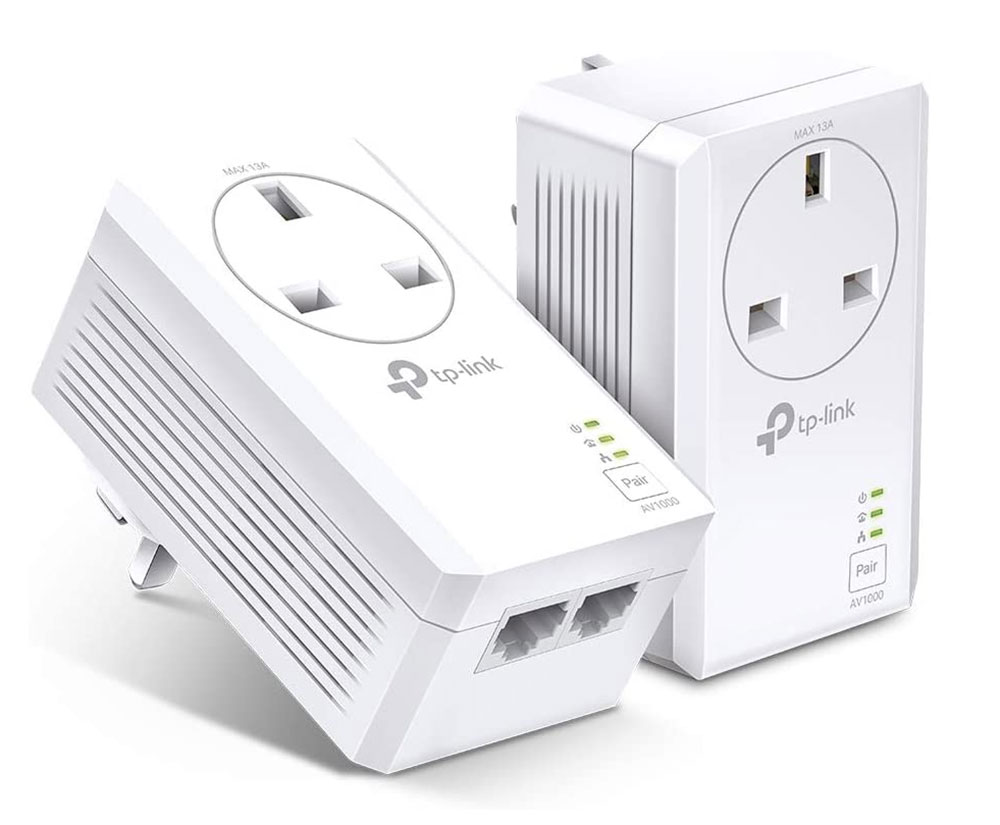
AV1000 Gigabit Passthrough Powerline Starter Kit (TL-PA7017P KIT) One Gigabit Ethernet port and passthrough socket per adapter: $59.99 / £49.99 The TL-PA7017P KIT has the same features as the TL-PA7017 KIT but with adapter units each with a pass-through socket. Because of the sockets, these adapters are slightly larger than those of the TL-PA7017 but they are still some of the smallest we’ve tested. Again, there’s no functionality to create a new Wi-Fi hotspot in the second room, and just one Gigabit Ethernet port per adapter, so it’s a basic system—although one that we think will be fast enough for most purposes.
TP-Link
AV1000 2-Port Gigabit Passthrough Powerline Starter Kit (TL-PA7027P KIT) Two Gigabit Ethernet ports and passthrough socket per adapter: £66.99 This starter kit is the same as the TL-PA7017P KIT but with two Gigabit Ethernet ports on each adapter, so you can connect two smart devices in both rooms.

AV1000 Gigabit Powerline ac Wi-Fi Kit (TL-WPA7517 KIT) Wi-fi hotspot and one Gigabit Ethernet port per adapter: $89.99 / £69.99 This Wi-Fi Powerline starter kit has two different adapters. The base unit that plugs into the router is tiny (it’s the same as with the entry-level PA7017), while the second-room adapter is about twice the size but includes the extra Wi-Fi hotspot so you can have not just fast wired but fast wireless connections away from the router.

AV1000 Gigabit Passthrough Powerline ac Wi-Fi Kit (TL-WPA7617 KIT) Wi-fi hotspot and one Gigabit Ethernet port per adapter, one with passthrough socket: $99.99 / £79.99 This Powerline Wi-Fi starter kit is basically the same as the TL-WPA7517 KIT but with the base adapter boasting a passthrough socket (the same as the PA7017P). We like a passthrough socket as it saves you from losing one where you plug it in near to the router. You can decide whether it’s worth the extra cost. Note that you shouldn’t plug a Powerline adapter into an extension lead or power strip as it will reduce performance, making the passthrough on the adapter even handier.
So which TP-Link AV1000 Powerline do you need?
The first determining factor when choosing a Powerline adapter is whether you want to create a strong new Wi-Fi hotspot in other rooms in the building.
If your home has patchy Wi-Fi away from the router, we recommend a Powerline setup with Wi-Fi functionality—at least for the phones and tablets that you can’t plug an Ethernet cable into. The TP-Link WPA-7617 Kit is our pick because of its passthrough socket saving you a power source near your router.
If the Wi-Fi is acceptable everywhere, then you can save money without paying extra for a Powerline that’s able to offer a new hotspot for you. If you have just one smart device to connect, go for the TP-Link PA-7017P Kit.
The next factor is how many devices you want to connect to fast wired Internet access. Only one of the TP-Link systems (the PA-7027P) has more than one Gigabit Ethernet port, although you could connect to an Ethernet Switch that adds extra ports to split the signal over.
If you want to connect a smart TV, Sky box or Tivo, games console and laptop, look for a Powerline adapter with multiple Ethernet ports. TP-Link’s own TL-PA8033 AV1300 has a second-room adapter with three Gigabit Ethernet ports, and both adapters have pass-through sockets, for not much more than the AV1000.
What TP-Link is missing in its Powerline range is a top-end all-function product, with more than one Ethernet port, Wi-Fi and passthrough sockets. The TL-WPA7617 comes closest but boasts just the one wired Gigabit Ethernet port on each of its adapters. At least one more on the second-room adapter would have made this an ideal Powerline kit.
If you want multiple Ethernet ports, pass-through and Wi-Fi you should consider Devolo’s Magic 2 Wi-Fi Next or the ASUS PL-AC56 KIT Powerline Extender .
TP-Link AV1000 Gigabit Powerline: speed tests
We tested the TL-WPA7517 KIT in a three-storey Victorian townhouse, with the modem/router on the top floor and the second adapter on the ground floor—nicely placed for the TV and SkyQ box.
And it passed our speed tests with top marks. Speeds will always depend on each particular building and its wiring, plus other environmental matters, so the results may well be faster or slower in your home, but we test every Powerline adapter in the same building so we can compare in a like-for-like situation.
First, we put the two adapters next to each other to test the fastest possible scenario—although not a very realistic one.
The AV1000 managed to reach speeds of 373Mbps—which is among the highest we’ve recorded in several years of testing.
When we moved the second adapter to a room two floors below the router we recorded speeds of 130Mbps. That might not sound much, but it’s certainly fast enough to stream your Netflix shows to your TV or computer.
Finally, we tested it using the new TP-Link Wi-Fi hotspot, and it came in at a very respectable 81Mbps—not far below the 90Mbps we recorded with the TP-Link AV1200.
These results were as good or better than the supposedly faster AV1200 TP-Link Powerlines, so you can save some money and not suffer any real speed loss with the AV1000 range.
Specs
TP-Link AV1000 Powerline: Specs
- Maximum speed: 1,000Mps. Some models include multiple Ethernet ports, pass-through sockets and Wi-Fi options.
Best Prices Today: TP-Link AV1000 Powerline
Author: Simon Jary, Contributor, Tech Advisor

Simon has over 30 years of expert experience testing and reviewing ever-smaller and more powerful tech accessories, from USB-C and Thunderbolt docks to chargers, batteries, hubs and adapters. A former Editor of Macworld, he has contributed to PCWorld, Tech Advisor and TimeOut, as well as national newspapers such as The Times, Independent and Telegraph.
Recent stories by Simon Jary:
- Best Powerline Adapters: Improve your home network speeds
- 6 ways to extend your Wi-Fi range
- How to Speed up a Home Network: Tips to Boost Wired & Wi-Fi

At a Glance
Expert’s Rating
Pros
- Fast Powerline
- Up to WiFi 6
- Advanced Mesh Wi-Fi features
Cons
- 2,400Mbps Powerline not double 1,200Mbps speeds
Our Verdict
This isn’t simply a Powerline kit with Wi-Fi. Devolo has combined the latest Powerline standard with fastest Mesh Wi-Fi to create the best of both worlds. It means the Magic 2 WiFi 6 Mesh kit is ideal for homes with very thick walls or the largest homes and can provide fast Wi-Fi everywhere. You can expand it with extra adaptors and,overall, it’s very good value when compared with traditional Wi-Fi-only Mesh systems.
Devolo has updated its top-end Magic 2 WiFi Powerline family with a new Magic 2 WiFi 6 Mesh product that adds the latest and fastest Wi-Fi standard to the range.
There are over 10 models of Devolo Magic to choose from (from the basic Magic 1 LAN to the flagship Magic 2 Wifi 6 Mesh), and we untangle the multiple choices for you in this review.
For the very fastest wired and wireless network, the Magic 2 WiFi 6 Mesh kits ( Starter Kit, £299.99 ) mean you can turn off your router’s wireless signal to create a full WiFi 6 Mesh network, unrestrained by the router’s likely slower Wi-Fi protocol.
The LAN + WiFI Magic 2 WiFi 6 kits ( Starter Kit, £199.99 ) do have Mesh features but can’t turn a home network completely WiFi 6. More details on each product below.
Note that the WiFi 6 products are not available in the US. Americans should look to the Devolo Magic 2 WiFi 5 Next Starter Kit .
Like the rest of its WiFi range, the Magic 2 WiFi 6 features new technologies that can significantly increase wireless speeds in your home.
Devolo’s latest range of home-network systems offers a combination of next-generation Powerline and advanced Mesh WiFi features, especially powerful for larger data-hungry homes.
Alone among Powerline providers, Devolo uses the latest chipsets and technologies to create the fastest home network.
Broadband is trying to keep up with super-fast services of over 350 megabits per second (Mbps).
But as we move to 4K TVs (with 8K on the horizon), and with a set in more than one room, with everyone in the house always on their phones, pushing that data around the home is not easy. One room might be fine, but today we expect every room to be up to speed with our demands.
Our main recommendation to improve your home network is installing a Powerline network.
Powerline is an extremely easy-to-setup solution that uses the power cables in your home to carry data around the building. See What is Powerline?
With Powerline, you can add wired Ethernet ports in different rooms and also—with some specially equipped Powerline adapters – add powerful new Wi-Fi hotspots.
Another solution—useful for larger homes—is to install a Mesh Wi-Fi network, which lets you place wireless extenders around your home to boost wireless signals.
In a Mesh system, there’s a main router connected directly to the modem, and then extra modules (known as nodes) placed through the home (as many as your space requires). Mesh satellites communicate with each other and create a single wireless network, sharing the same SSID and password so your devices seamlessly connect and disconnect from individual nodes in the background as you move around.
Mesh Wi-Fi systems work well, but can be held back by Wi-Fi’s innate failings when it comes to distance from your router. See Best Mesh Wi-Fi Networks .
German manufacturer Devolo has been one of the pioneers of the Powerline industry for over 15 years and is a benchmark for speedy and stylishly designed adapters.
Its top-end product, Magic, takes Mesh Wi-Fi and adds Powerline as the backbone, therefore making the signals much stronger than from a traditional Mesh system.
The technical stuff (skip if you feel queasy)
The weakness of Mesh is that the data backbone remains Wi-Fi, which, as we all know, gets weaker the further it is away from the original source (usually the router) and is further blocked by floors, ceilings, walls and even furniture.
By using the physically wired Powerline to carry the signal around the home, Devolo claims that there is significantly less weakening of the signal, and therefore the faster downloads in each room.
In addition, Magic 2 uses the second generation of G.hn Powerline chips (Gigabit Home Networking), which boasts data rates up to 2.4Gbps (gigabits per second).
In comparison, most other Powerline adapters are based on the HomePlug AV2 standard that has a maximum data rate of 1.2Gbps.
G.hn also has a greater range: 500 metres compared to AV2’s 400 metres.
With more homes being supplied with super-fast gigabit fibre, such advances are welcome—especially as the speeds quoted are maximum theoretical data rates rather than the real-world speeds you’ll actually get in your house.
G.hn will never reach its 2.4Gbps maximum, but it should be significantly faster in real-world environments than the older HomePlug AV2.
G.hn adapters are incompatible with HomePlug, but two different networks can co-exist in the same electrical circuit. However, to get the fastest speeds, it’s recommended not to mix G.hn and HomePlug products.
Many Powerline adapters offer the option of adding new Wi-Fi hotspots in your home, but only Devolo has added the latest Wi-Fi 6 standard on its very top-end models but retains slightly cheaper Wi-Fi 5 models, too.
Wi-Fi 6 (also known by the less snappy title 802.11ax) can boost Wi-Fi speeds by up to 50%, by smartly cramming more data into one channel. Multi-user Multiple-Input, Multiple-Output (MU-MIMO) and Orthogonal Frequency-Division Multiple Access (OFDMA) are two of the most significant technical enhancements in WI-FI 6. Both are multiuser technologies that enable simultaneous bidirectional communication between an access point (AP) and end-users.
Wi-Fi 6 has even more up its sleeve. Target Wait Time helps devices conserve power, and prevents channel contention. And Basic Service Set (BSS) Coloring reduces interference due to congestion, ensuring consistent service to multiple connected devices in high-density environments.
All you need to know, though, is that Wi-Fi 6 is the fastest consumer Wi-Fi there is right now. For more, read our explainer on what is Wi-Fi 6 .
Wi-Fi 6 is, like all most other Wi-Fi standards, backwards compatible. WiFi 6 access points work with “older” Wi-Fi 5 and Wi-Fi 4 end devices and access points (routers, repeaters, etc).
But to enjoy the full advantages of the new Wi-Fi 6 features (QAM 1024, OFDMA, TWT, BSS Coloring…) the access point and the end devices must support Wi-Fi 6.
That said, if end-users install a Wi-Fi 6 network while having Wi-Fi 5/4/3 devices at home, they can be sure that it is future-proofed and also that the Wi-Fi speed and stability will increase.

Set-up is much easier than it sounds
That was the technical explanation. Don’t panic! Setting up a Powerline network is simple.
A typical starter kit comes with two Powerline adapters. One is the base unit that connects directly to your router via a supplied Ethernet cable and is plugged into a power socket nearby. The other Powerline adapter is plugged into a wall socket in the second room you need the fast access in—most likely a living room or home office with smart TV, games console, etc. You can connect these devices to the second adapter via Ethernet cable and/or create a new Wi-Fi hotspot there (if the Powerline adapter boasts this function).
If you have multiple devices that require a wired connection, look for a Powerline adapter with more than one Ethernet port. The Devolo solution is available in several versions, which we’ll list individually later.
With Devolo Magic, once you’ve plugged in the first adapter, all other adapters that are plugged in within the next two minutes are automatically connected to each other—without you having to push a single button. During this pairing process, a unique security ID is exchanged between the devices, making the installation extra secure.
You don’t have to change the settings of your router—it’s plug & play and easier than installing most Mesh-WiFi systems, where you have to change the settings of your router.
Devolo Magic systems and pricing
There are six types of Magic (Magic 1 LAN, Magic 1 WiFi, Magic 2 LAN, Magic 2 WiFi 5, Magic 2 WiFi 6, and Magic 2 WiFi 6 Mesh), each with different configurations.
Magic 1 ’s maximum (theoretical) speed is 1,200Mbps. Devolo believes this is more than capable of providing a network fast enough for everyday home-office and browsing applications, plus HD streaming. Magic 1 is unavailable in the US.
Magic 2 has a max (again theoretical) speed of 2,400Mbps. This extra speed is recommended for UltraHD streaming and particularly busy data-download homes.
An adapter is labelled either just “ LAN ” (Local Area Network, or just plain wired network to you and me, with Gigabit Ethernet port) or “ Wi-Fi ” that can create a new wireless hotspot in the second room and usually also includes two LAN Gigabit Ethernet ports. The Wi-Fi adapters use either Wi-Fi 5 or Wi-Fi 6.
You can mix and match products, but make sure you have your fastest base unit connected directly to the router. If the router is connected to a Magic 1 adapter, then all units in the house will be restricted to that speed. If a Magic 2 adapter is connected to the router, then you can add Magic 1 and Magic 2 adapters, and each point is then fine at its own theoretical maximum.
Here are the main options for Starter Kits that include two adapters: one base adapter to connect to your router, and one second-room adapter to plug in near the smart devices you need to add wired access to and/or add a new Wi-Fi hotspot.
There are also Whole Home Kits that have the base adapter and two extra-room adapters.
The Magic 2 WiFi kits all have Mesh capabilities, but to create a full Mesh wireless network you should have a Wi-Fi adapter as your base, rather than a standard LAN adapter, so you can create a new wireless network without needing the router’s own. This will be especially true with the Magic 2 WiFi 6 Mesh kits.

Devolo Magic 1 LAN Starter Kit
• Max speed: 1,200Gbps • One Gigabit Ethernet port on each adapter (both Magic 1 LAN)
The entry-level Magic 1 LAN Starter Kit product offers fast up to 1,200Mbps Powerline connections around the home but lacks the ability to create new Wi-Fi hotspots or a wireless Mesh network. Each adapter has one Gigabit Ethernet adapter for wired device connections. A Magic 1 LAN Starter Kit (with one base unit and one second-room adapter) costs £99.99 . You can add extra single adapters for £54.99 each.
(Magic 1 is not available in the US.)

Devolo Magic 1 WiFi Starter Kit
• Max speed: 1,200Gbps • One Gigabit Ethernet port on base LAN adapter and two on the WiFi 5 adapter
As its name suggests, the Magic 1 WiFi Starter Kit adds wireless (and some Mesh) functionality. The Wi-Fi adapter features two Gigabit Ethernet ports, so you can connect more than one data-hungry device in the second or third room. The Magic 1 WiFi Starter Kit costs £134.99 ; a three-pack Whole Home Kit set with two secondary Wi-Fi adapters costs £199.99 . You can buy extra single Wi-Fi adapters for £69.99 each.

Devolo Magic 2 LAN Starter Kit
• Max speed: 2,400Gbps • One Gigabit Ethernet port on each adapter (both Magic 2 LAN)
The Magic 2 LAN Starter Kit features the faster Powerline speed but no Wi-Fi hotspot. The Magic 2 LAN Starter Kit costs £129.99 or $134.99 for adapters with one Ethernet port. Extra one-port adapters cost £69.99 or $74.99.

Devolo Magic 2 LAN Triple Starter Kit
• Max speed: 2,400Gbps • One Gigabit Ethernet port on the base adapter and three ports on the second-room adapter.
The three-port version of the Magic 2 LAN Starter Kit with triple Ethernet costs £139.99 or £144.99 , with an extra single three-port adapter priced at £79.99 or $84.99. This is a good option if you have multiple devices that require a wired Internet connection, but there’s no extra wireless hotspot function.

Devolo Magic 2 WiFi 5 Next Starter Kit
• Max speed: 2,400Gbps • One Gigabit Ethernet port on base LAN adapter and two on the WiFi 5 adapter
The Devolo Magic 2 WiFi 5 Next features faster Powerline speeds plus the Wi-Fi hotspot and Mesh capability. The basic Magic 2 WiFi Next Starter Kit costs £174.99 or $184.99 for one base adapter (with one Gigabit Ethernet to connect to your router) and one second-room Wi-Fi Powerline adapter (with two Gigabit Ethernet ports to connect to your smart devices plus the Wi-Fi hotspot). The slightly misleading “Next” part of the name once indicated new features from the original Magic 2 WiFi 5 kit that are now standard for Magic 2 WiFi models. Just think of it as the Magic 2 WiFi 5.

Devolo Magic 2 WiFi 5 Mesh Starter Kit
• Max speed: 2,400Gbps • Two Gigabit Ethernet ports and Wi-Fi 5 on both base adapter and the second-room adapter
The Devolo Magic 2 Mesh WiFi 5 is a full Mesh kit as it has two Ethernet ports and Wi-Fi hotspot on both the base and second-room adapter. It’s available as a £199.99 Magic 2 WiFi Next Starter Kit. This means you can ditch your router’s wireless signal if you want, but as your router is likely at least Wi-Fi 5 it won’t make much difference to speed.
An extra single Magic 2 WiFi adapter costs £114.99 or $124.99 . You can add as many as you like, depending on the size of your home and networking needs, or buy the Whole Home Kit if you need three.

Devolo Magic 2 WiFi 5 Mesh Whole Home Kit
• Max speed: 2,400Gbps • Two Gigabit Ethernet ports and Wi-Fi 5 on the base adapter and the second- and third-room adapters
To get the full benefit of Mesh (and if you have a larger home) then the Multiroom Devolo Magic 2 Mesh WiFi Next 5 Whole Home Kit is a three-pack (with the base unit and two extra room adapters; all with two Gigabit Ethernet ports and Wi-Fi hotspot) priced at £274.99 .

Devolo Magic 2 WiFi 6 Starter Kit
• Max speed: 2,400Gbps • One Gigabit Ethernet port on base LAN adapter and two on the WiFi 6 adapter
The Devolo Magic 2 WiFi 6 Starter Kit features one base adapter (with one Gigabit Ethernet to connect to your router) and one second-room Wi-Fi Powerline adapter (with two Gigabit Ethernet ports to connect to your smart devices plus the super-fast Wi-Fi 6 hotspot), priced at £199.99 for the Magic 2 WiFi 6 Starter Kit or £349.99 for the Whole Home Kit with one base adapter and two Wi-Fi adapters.
The WiFi 6 models are not available in the US.

Devolo Magic 2 WiFi 6 Mesh Starter Kit
• Max speed: 2,400Gbps • Two Gigabit Ethernet ports and Wi-Fi 6 on both base adapter and the second-room adapter
The top-end Mesh WiFi 6 Mesh Starter and Whole Home Kits are perfect to replace the Wi-Fi of the router. To have a 100% fully integrated, native Wi-Fi network, which works perfectly together, you should go for the upcoming Mesh WiFi 6 Kits.
The Devolo Magic 2 Mesh WiFi 6 Starter Kit ( £299.99 ) has two Ethernet ports and fast Wi-Fi 6 hotspot on both the base and second-room adapter.
If your router is WiFi 5, then you can turn off its wireless signal and turn your home network into a full WiFi 6 Mesh system.

Devolo Magic 2 Mesh WiFi 6 Whole Home Kit
• Max speed: 2,400Gbps • Two Gigabit Ethernet ports and Wi-Fi 6 on the base adapter and the second- and third-room adapters
A £449.99 Magic 2 Mesh WiFi 6 Whole Home Kit has three of the same in one pack. This is the ultimate Mesh Wi-Fi kit for larger homes.
Again, for the fastest Wi-Fi speeds, you should turn off your router’s wireless signal and just use the Devolo WiFi 6 Mesh network.
Not cheap but offers a lot
This might seem expensive but if it noticeably speeds up your home network then it’s a one-off payment worth making.
While it seems pricey compared to other Powerline kits, it’s not so far off other Mesh systems. The closest comparison is TP-Link’s £349 Deco X60 , which also uses Powerline (based on the older HomePlug standard) as the Mesh backbone for a three-pack like the Whole Home Magic 2 Mesh WiFi.
One of our favourite Mesh systems (the Linksys Velop Dual Band ) costs £219 for the three-pack but doesn’t have the benefit of the Powerline backbone.
The Google WiFi Mesh system costs £329 for the three-pack, so the Devolo Magic 2 Multiroom isn’t the most expensive.
All the Magic adapters boast a pass-through power socket, which means you don’t lose a plug point when it’s installed.

Devolo Magic LAN features
Lacking the ability to add extra Wi-Fi hotspots or create Mesh Wi-Fi networks, the more basic LAN versions of Magic are more like conventional Powerline kits. Plug one adapter into a socket near your router, wire it to the router via Ethernet cable. Get the second adapter, and plug that into a power socket near the device you want to improve the data speed to (say, your smart TV), and then connect that adapter to the device via another Ethernet cable.
It’s like having one long cable from your broadband router to your smart TV; see illustration above.
Devolo Magic WiFi features
With the WiFi versions of Magic you get to either add a second Wi-Fi hotspot (of similar speed to what you’d get standing next to the router) in another room far away.
On top of this is the Mesh functionality that can create the fastest-possible wireless network in your home. Devolo’s Magic WiFi kits feature the latest Mesh technologies but for best results look for the Magic 2 “Mesh WiFi” kits that have Wi-Fi (either 5 or 6) on the base adapter that plugs into your router as well as on the extra-room adapters.
Magic WiFi systems feature “ Fast Roaming “—a lso known as IEEE 802.11r or client steering— that works so that all wireless clients, such as smartphones and tablets, are always connected to the strongest Wi-Fi hotspot. When you move from room to room with your mobile device, it will discover and connect with the fastest hotspot.

Access Point Steering improves on Fast Roaming technology by determining which wireless devices require the fastest connection. Older devices aren’t always Fast Roaming compliant and allowing the device to choose the access point could slow down other devices on the network.
Access Point Steering, on the other hand, lets the Wi-Fi access point decide which devices need to hand over at the most appropriate time. This improves overall performance because the system knows about all the devices in the home, rather than one device deciding what it needs in isolation.
Integrated “ Band Steering ” further ensures that all Wi-Fi clients are automatically assigned to the best wireless channel and the optimum frequency.
“ Config Sync ” allows the router‘s WiFi configuration data to be transferred with ease to all WiFi access points (using a single SSID).
An “ Airtime Fairness ” feature processes the requests of faster wireless clients at a higher priority, preventing older devices – which may require more time for a download—from creating WiFi bottlenecks.

Devolo uses MU-MIMO in its new products. MU-MIMO stands for multi-user, multiple input, multiple output, and is a wireless technology supported by routers and endpoint devices.
This allows the Wi-Fi access point to deliver up to four streams to four different devices, or clients.
As mentioned earlier, you should buy the latest Wi-Fi 6 kits to future-proof your home’s wireless network—even if not all your devices are Wi-Fi 6 ready, they will be eventually and a Powerline system doesn’t need replacing every couple of years like most technology.
WiFi 6 adds even more wireless benefits, such as Target Wake Time (TWT), OFDMA and BSS Coloring—see earlier for full explanations.
Its MU-MIMO is bi-directional , so works on both your device and adapter receiving and sending data, whereas WiFi 5 works only on sending data.

Devolo Magic Powerline speed tests
As with all our Powerline and Mesh reviews, we test in a real-world environment—in this case, a three-story Victorian townhouse. Remember that no one home is identical to another, so you may get faster or slower results than we do. But rest assured that in comparing different system we should have a decent idea of which comes out as the top performer.
We tested the Magic 2 system with Wi-Fi 5. With its maximum speed of 2,400Mbps we expected great things, although in the knowledge that such theoretical speed claims (by all networking manufacturers, not just Devolo) won’t be reached in our imperfect homes, with their troublesome walls, ceilings and other electrical devices causing noise and data barriers.
First, we tested the Powerline connection at its fastest, by placing one adapter in the same room as the base Powerline adapter that is connected to the router.
In our real-world test environment, we achieved an impressive speed of 456Mbps—our fastest in all Powerline tests we’ve performed so far in this test environment.
Next, when tested in a more realistic setup with the second adapter in a room two floors away, speed predictably dropped—here to 119Mbps. (Remember that you might well get much faster than this in your own home, and we have seen reports that switching off Sonos speakers greatly improved speed, which we will check on soon.)
This was actually a little slower than previous tests we had run using TP-Link’s AV1000 Powerline Adapter Starter Kit (TL-WPA7510), where we nudged closer to 130Mbps, but the difference is minimal really and could easily be explained by the time of day when we ran the tests. That said, the Magic’s G.hn Powerline chips didn’t blast past the older HomePlug standard as much as we had expected and that makes us wonder whether the 2,400Mbps potential is really going to make much difference in the wild.
Our third test was on the Wi-Fi performance in the second room (far from the original wireless router). In a non-Mesh trial, we achieved 104Mbps, which isn’t so far off the wired speed and noticeably faster than our previous fastest Powerline Wi-Fi (90Mbps from Devolo’s own 1200+ Starter Kit ).
So, the Devolo Magic 2 WiFi 5 Kit performed about as well as our previous fastest Powerline winner and a little faster using its new Wi-Fi hotspot. We will update this review when we have tested the latest Magic 2 WiFi 6 models, which we expect to give much-boosted wireless performance.
Magic 2 WiFi Mesh tests
Later, we tested the Magic 2 WiFi 5 in our Mesh test environment, and this is where you can see that speeds in different places will differ wildly. We didn’t test wired Powerline connections here, just the Wi-Fi strength in the Mesh system.
The Mesh Wi-Fi side of things works well, although Devolo could put a little more effort into making its app and manual more helpful for first-time users. The Multiroom kit that we tested contained three adaptors – a LAN (base) adaptor for connecting to our existing router, and two Wi-Fi Powerline adaptors that you can place in other rooms.
However, the three adaptors all look very similar, and the manual doesn’t make it clear which adaptor should be connected to the router and which ones go into your other rooms. And, while trying to set up our new wifi network, the Devolo app on our tablet told us to ‘press the PLC button’ – without actually telling us to where find that button on the adaptors.
But, once we got past those initial hiccups, the Wi-Fi and Mesh networking features provided impressive performance.
With one of the Magic 2 Wi-Fi adaptors in a nearby hallway and the second adaptor in our office, we found that we were able to get a consistent Wi-Fi speed of around 700Mbps from both adaptors – outpacing a number of conventional Mesh systems that we’ve reviewed recently, and allowing us to move around freely with our laptop at last.
And, of course, if you’re still having problems with your Wi-Fi signal then the Magic 2 WiFi adaptors also provide two Gigabit Ethernet ports for wired connections (as well as that handy pass-through option for using your mains power socket too).
And while the Devolo app does have a few rough edges, it also provides a number of useful features as well. By default, the dual-band Wi-Fi adaptors create a single network that combines the 2.4GHz and 5GHz bands, but the app also allows you to split those into two separate networks if you want to, as well as providing a ‘clone’ option that allows the new Devolo network to use the same Wi-Fi name and password as your existing network.
The app’s parental controls could be more extensive though. There is an option to create a schedule that limits Internet access to specific times of day, but some rival Mesh devices also allow you to create more varied schedules and profiles that cater for children of different ages in your family.
However, there’s no doubt that the Devolo Magic 2 kit provides good performance for both wired and Wi-Fi connections, and that its versatile combination of Powerline and Wi-Fi networking can be extremely useful for larger homes that normally struggle to get a good Wi-Fi signal.
Devolo Magic vs TP-Link Deco P7
The Magic WiFi’s closest rival would be the TP-Link’s Deco P7, which also combines Mesh networking with Powerline connectivity. However, the P7 costs around £250 for a two-piece kit. The Magic 2 WiFi 5 Whole Home Kit costs £275, but provides a three-piece kit that lets you use its LAN/Powerline adaptor to connect to your existing router, and two separate Wi-Fi adaptors that you can place in other rooms – along with the useful mains pass-through socket option.
Admittedly, most homes won’t need a high-end kit such as this, but for larger homes that have trouble getting good Wi-Fi the versatility and performance of the Magic 2 WiFi Next will be ideal – and, of course, there’s also the option of the less-expensive (£169) two-piece Starter Kit for smaller homes.
We’re looking forward to the Magic 2 Mesh WiFi 6 models becoming available.
Mesh or just Powerline
As Mesh is really aimed at homes that require more than one extra wireless hotspot, smaller or average-sized properties might be better off just using standard Powerline adapters – with one extra Wi-Fi hotspot if required. Check for your Wi-Fi weak areas and where you need better wireless connections.
The Devolo Magic 1 WiFi 5 Kit costs from £135 for the Starter Kit with one base unit and one second-room Wi-Fi Powerline adapter with Wi-Fi.
For £85 the non-Mesh TP-Link TL-WPA7510KIT (two adapters, each with one Gigabit Ethernet port, one with Wi-Fi) offers comparable speeds (in our tests). With Magic, you are still a price premium for the more sophisticated Mesh features. Check out our roundup of the best Powerline starter kits to see our recommendations.
Where the Magic 1 and 2 win doesn’t appear to be straight-line Powerline performance, but they do make a reaal difference in homes that require more than one extra Wi-Fi hotspot, where the more advanced Mesh features should shine.
Most importantly, only Devolo offers full WiFi 6 Mesh capabilities.
(Additional reporting by Cliff Joseph.)
Verdict
The Devolo Magic 2 WiFi kits are best suited for larger homes that require more than one extra Wi-Fi hotspot. Here, the top-end Mesh features (Fast Roaming, Access Point Steering, MU-MIMO, Band Steering, Config Sync, and Airtime Fairness) should ensure you get the fastest WiFi possible wherever you are in the house.
The Magic 2 WiFi 6 Mesh kits could be real game-changers for your wireless home network, transforming your home network into a full Wi-Fi 6 network.
With Powerline, Mesh, pass-through sockets and two Ethernet ports, the Magic 2 is loaded with features.
Considering its top-of-the-range Powerline and Mesh features it compares well with similar Mesh systems on price.
Smaller houses can probably make do with just the one extra Wi-Fi hotspot, and there are cheaper Powerline Wi-Fi kits available that will do much the same job.
Author: Simon Jary, Contributor, Tech Advisor
Simon has over 30 years of expert experience testing and reviewing ever-smaller and more powerful tech accessories, from USB-C and Thunderbolt docks to chargers, batteries, hubs and adapters. A former Editor of Macworld, he has contributed to PCWorld, Tech Advisor and TimeOut, as well as national newspapers such as The Times, Independent and Telegraph.
Recent stories by Simon Jary:
- Best Powerline Adapters: Improve your home network speeds
- 6 ways to extend your Wi-Fi range
- How to Speed up a Home Network: Tips to Boost Wired & Wi-Fi
