At a Glance
Expert’s Rating
Our Verdict
The ZTE Axon Elite has great specs and some interesting tech at an excellent price, but while we appreciate many users will love the design we aren’t entirely taken by it – especially the fake-leather parts on the rear. If you can’t get the OnePlus 2, this is a close second best – and much easier to get hold of.
Best Prices Today: ZTE Axon Elite

ZTE Axon Elite review: UK price and availability
The Axon Elite was supplied to us by GearBest , a Chinese site that holds stocks at its EU warehouse, meaning you won’t have to pay import duty. Right now it’s on offer at £217.07 shipping from the EU warehouse. You’ll save some money if you buy from the Chinese warehouse (currently out of stock there mind), though you should read our buying advice first.
Given the device’s specifications it is difficult to argue with the price. A close rival is the OnePlus Two , which starts at £239.

ZTE Axon Elite review: Design and build
The Axon Elite’s design is going to appeal to some people, but others will dislike it. It’s a very fancy-looking phone, but it almost tries a little too hard – the extra detail stretches even to the volume rocker. If you like to be the centre of attention, the Axon Elite is definitely the phone for you. Also see: Best smartphones 2015/2016 .
The Axon Elite is made with sturdy-feeling, premium-looking aluminium, but has fake leather stitched portions at the top and bottom of the rear. These serve a practical purpose – it’s here that the antennae are housed and thus it removes the need for those lines we’re used to seeing on the side of metal phones to improve signal – but it detracts from the phone’s overall design and premium feel.
It’s a bit on the chunky side, at 9.3mm, and a large 5.5in screen and front-facing speaker grilles top and bottom add to the height. The ZTE feels good in the hand, but at times you will likely find yourself needing to use two. Also see: Best MiFi 2016 .
Mi-Pop is a software fesature that places onscreen a little widget that can make controlling the phone in a single hand much easier – you get quick access to a back button, wherever you like on the screen, or you can tap and hold to also access home, recents and options shortcuts.

The screen is a standout feature, a 5.5in full-HD (1920×1080 pixels) panel with 401ppi pixel density. It’s very bright, very clear, and with punchy colours. Viewing angles are strong, too – we only wish the glass sat flush with the metal frame top and bottom (at least with it being 2.5D aka curved it’s less likely to chip). Also see: Best Android phones 2015/2016 .
Our review sample came in a muted gold known as Ion Gold. What you think of this is entirely down to your personal preferences, but it does follow in the steps of several flagship phones that now have a gold colour variant.
The rear cover isn’t removable, so neither is the battery. It has some interesting features, though, with a rear-mounted fingerprint scanner (this is in addition to the eye-unlock feature) and two cameras plus two LED flashes. We’ll talk more about these later.

You insert your SIM using the tray on the left side. The ZTE Axon Elite can accept two nano-SIM cards – the first with support for all three UK 4G LTE bands, but the second won’t support a data connection. Also see: Best dual-SIM phones and dual-SIM buying advice .
Below this SIM tray sits a volume rocker, which sits right under your finger when used in the right hand. Over on the right edge is a power button, while at top is a 3.5mm headphone jack and at the bottom a Micro-USB charging slot.
The back and recents software buttons sit either side of the Home button below the screen, and usefully you can switch around their function in the settings.
ZTE Axon Elite review: Security
One of the most interesting features of the Axon Elite is its security and unlocking options, of which there are several. You can choose to use a passcode, the eye-scanner or the fingerprint scanner on the rear, or alternatively voice unlocking. It’s a bit much, but it can come in useful if you’ve only got one hand free – or none, since you can say ‘open sesame’ or ‘phone unlock’ to unlock the phone with your voice.
This isn’t the first time we’ve seen the eye-unlocking technology used by ZTE. At MWC earlier this year we saw the ZTE Grand S3 using the tech and it attracted lots of attention, so it makes total sense for the company to bring the great idea to other smartphones in its line-up. But it is the first time we’ve seen three biometric security features in one ZTE smartphone.
Unfortunately, our main issue with this type of biometric security that it is still only as secure as your passcode – you can bypass both the eye scanner and the fingerprint scanner. Still they are cool additions and certainly a talking point. And in our tests they worked first time every time.

ZTE Axon Elite review: Cameras
The camera features are also interesting, but not so unusual these days as HTC and Huawei have recently used similar tech in their smartphones. We’re talking about the dual lenses at 13Mp and 2Mp paired with a dual LED flash, which means you can capture images that can be refocused later, making for some brilliant results. We also quite like the ability to capture multiple exposures in one image for a dreamy effect.
The camera on the front is an impressive 8MP. You’ll also be able to capture 4K videos using the rear-facing camera. Also see: Best phone camera 2015/2016 .

ZTE Axon Elite review: Hardware and performance
We’re so used to seeing MediaTek processors inside Chinese phones that the Qualcomm Snapdragon 810 paired with 3GB of RAM came as quite a surprise – a nice one, though. The ZTE Axon Elite feels like a fast, high-performance phone in every way, and even downloading the apps we use for benchmarking seemed less of a chore than usual.
We ran the ZTE Axon Elite through our usual benchmarks and recorded 3990 points in the multi-core component of Geekbench 3 (1257 single-core), making it a touch slower than the OnePlus 2 but above phones such as the HTC One M9 and Google Nexus 5X .
In AnTuTu, which also measures overall performance, the ZTE Axon Elite recorded a very good 49,547 points, which is again below the OnePlus 2 but still a very decent score.
We use GFXBench to test graphics performance, and here the ZTE Axon Elite scored a very high 19fps in Manhattan and 53fps in T-Rex. That’s an excellent score for an Android phone, tying it with the Sony Xperia Z5 and beaten only by the current-generation iPhones and the Sony Xperia Z5 Premium.

Our final test is SunSpider, in which the ZTE managed a very decent 704ms. Once again, here it beat the OnePlus 2 by some distance.
You can compare the ZTE Axon’s performance to all the phones we’ve recently tested in our article what’s the fastest smartphone 2015/2016 .
The ZTE Axon Elite has 32GB of internal storage, which is expandable up to 128GB with a microSD card, and offers 4G LTE, Bluetooth and 802.11ac Wi-Fi. There’s a generous 3000mAh battery inside, but as we mentioned earlier it’s not removable – if you want to top up your phone on the go your best bet is a power bank .
ZTE Axon Elite review: Software

ZTE is running Android 5.0 Lollipop on the Axon Elite, with ZTE’s own MiFlavor interface that ditches the app drawer in favour of home screen icons and folders. We’d prefer a more vanilla Android ideally, and can’t say we like the design of ZTE’s icons, but it’s simple to use and we found it to be smooth and responsive during our brief time with the handset.
The most notable difference we found is in the Settings menu, whereby you are first shown a screen of quick-access Settings and must swipe right to see the standard Android Lollipop settings menu.
The Axon Elite also supports some smart gestures for closing and switching apps, taking screenshots, automatically sending and receiving or muting calls and the like. And there’s the aforementioned Mi-Pop feature, which may help you more easily control the large screen with one hand.
See all smartphone reviews .
Specs
ZTE Axon Elite: Specs
- Qualcomm Snapdragon 810 64-bit octa-core processor
- Adreno 430 GPU
- 3GB LPDDR4 RAM
- 32GB storage (plus microSD support up to 128GB – uses second SIM slot)
- Android 5.0.2 Lollipop
- 5.5in full-HD (1920×1080, 401ppi) IPS display with 2.5D curved glass
- 802.11b/g/n Wi-Fi
- Bluetooth 4.0
- NFC
- GPS
- dual-SIM dual-standby (2x Nano-SIM)
- supports 800/1800/2600MHz 4G LTE
- 13Mp, f/1.8 Sony IMX214 + 2Mp rear cameras with dual-LED flash, 4K video recording
- 8Mp front camera
- Hi-Fi Audio chipset AKM 4961
- fingerprint scanner
- EyePrint ID eye recognition
- 3000mAh non-removable battery with Quick Charge
- 154x75x9.3mm
Best Prices Today: ZTE Axon Elite

Recent stories by Ashleigh Macro:
- Best Samsung Galaxy S10 Deals
- The best OnePlus 6T cases
- How to unlock an iPhone and use any SIM
At a Glance
Our Verdict
It’s interesting to see a new development in mobile security being implemented in ZTE’s Grand S3, but it’s certainly not the most ideal or practical feature, and it’s essentially the only thing that makes this smartphone stand out from the crowd. That said, its specs make it a good all-rounder that, should it make its way to the UK, could attract some intrigued buyers thanks to the Eyeprint ID.
Best Prices Today: ZTE Grand S3
ZTE’s Grand S3 was the star attraction at its stand at MWC 2015 in Barcelona, attracting crowds mainly looking to try out the feature that allows you to use your eyes as your password. We went hands-on (and eyes-on) with the new smartphone to bring you our ZTE Grand S3 hands-on review.
ZTE Grand S3 hands-on review: Design & build
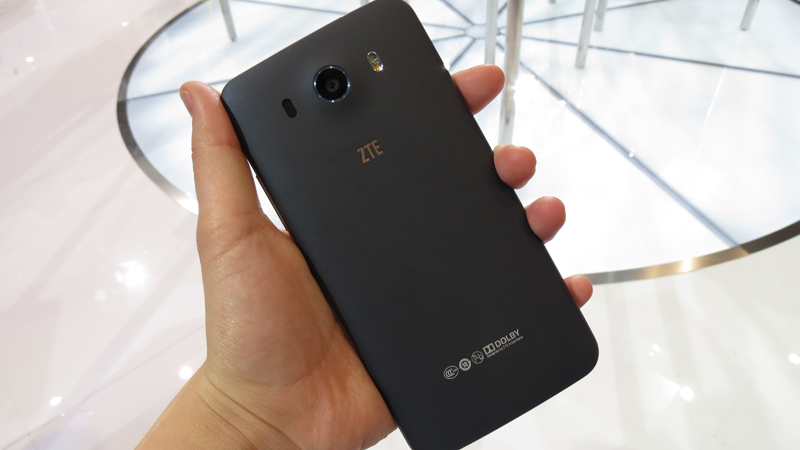
The ZTE Grand S3 has a smooth plastic back with a metal frame, which helps make this smartphone look and feel great. It’s not pretending to be a high-end, premium smartphone, but there’s also nothing about it that screams budget or cheap.
It’s not too thick or chunky at 9.8mm, and felt light and comfortable to hold during our testing. The rear camera does protrude from the rest of the smartphone slightly, but we quite like the symetrical design on the back as shown below.
ZTE Grand S3 hands-on review: Hardware & specs
The Grand S3 is a large smartphone that almost crosses into the phablet category with a 5.5in screen. That display is an IPS LCD with a resolution of 1920 x 1080, so that’s the same pixel density as Apple’s iPhone 6 Plus at 401ppi, and we’re impressed.
Inside the Grand S3, you’ll find a Snapdragon 801 chip with a quad-core Krait 400 CPU clocked at 2.5GHz, paired with 3GB of RAM and boasting Adreno 330 graphics. That should make this smartphone pretty zippy, and during our time spent with the device we had no lag when switching between applications or launching apps, but we’ll need to wait until we’ve got it back to our labs for full benchmark testing to find out how it really performs in comparison with rivals.
You’ll get 16GB of built-in storage, but that’s expandable thanks to the microSD card slot.
When it comes to connectivity, the Grand S3 offers 4G LTE connectivity as well as 802.11ac WiFi. There are two SIM card slots, and Bluetooth 4.0.
The battery is 3,100 mAh, and thanks to the removable back cover it’s replaceable.
ZTE Grand S3 hands-on review: Cameras

The cameras on the Grands S3 are impressive, with a 16Mp rear-facing camera with a dual LED flash, and an 8Mp front-facing camera for selfies, but also for that cool eye-unlocking feature we’ve mentioned and will go into more detail about below. Both cameras seemed to capture impressive photographs during our testing.
The camera’s Pro mode allows you to tweak your settings to capture better photographs. You can adjust the ISO, white balance and more.
ZTE Grand S3 hands-on review: Additional features

The stand-out feature of the ZTE Grand S3 is the Eyeprint ID feature, which allows you to unlock the smartphone using just your eyes, a bit like the way fingerprint sensors allow you to use just your finger to unlock smartphones including Samsung’s Galaxy S6 and the iPhone 6 .
The new biometric authentication technology comes from American company EyeVerify, which uses the front-facing camera to identify blood vessel patterns in your eyes.
It’s interesting, that’s for sure, and certainly attracted our attention. However, in reality, using your eyes to unlock your smartphone isn’t very practical, and is much more fiddly and awkward than simply using your fingerprint.

To use the feature, you swipe down from the top of the lock screen and then line your eyes up with the green line shown on screen. If it recognises you as a match, you’re in, but the scanning time is a good few seconds and you’ll need to hold the smartphone in a particular way in front of your face for it to work.
It does work well, though, and even if you’re wearing glasses which we were pleased to see. If it’s too dark, of course, it’s unlikely that the Eyeprint ID technology will work because it needs to be able to see your eyes, and ZTE hasn’t included a front-facing flash to solve that issue.
The technology does get better and more secure you move it, though, each time capturing more information about your eyes. Right now it’s only used to unlock the smartphone but ZTE plans to use it for mobile banking and other applications in the future, too.
ZTE Grand S3 hands-on review: Software
The Grand S3 is running Android 4.4 KitKat, with ZTE’s My Favourite UI user interface, which is colourful and fairly simple, with the use of folders rather than an app drawer. There’s no sign of an Android 5.0 Lollipop update just yet, though.
ZTE Grand S3 hands-on review: Price & availability
ZTE’s Grand S3 is currently only available in China at a price of 3000 yuan, which translates to around £310, but the company has said that it plans to bring the smartphone to other parts of the world later in the year.
Best Prices Today: ZTE Grand S3
Recent stories by Ashleigh Macro:
- Best Samsung Galaxy S10 Deals
- The best OnePlus 6T cases
- How to unlock an iPhone and use any SIM
